Guides
High chair weight limits, explained
The number on the label is not a guess at when your child will outgrow the seat. It is the load the chair's stability and structural testing was carried out against.
How this page is funded: if you buy through a link here we may earn an Amazon commission, at no extra cost to you. It never changes which product we put first, and we recommend the cheaper option whenever it is the better one. Full disclosure.
The short answer
A high chair's weight limit is the load its stability and structural testing was performed against — past it, the testing simply does not cover your situation. There is no single industry figure: limits vary enormously between a moulded plastic seat and a wooden convertible, and a convertible chair usually has a different limit for each stage. Find yours on the label under the seat, on the maker's own product page, or in the manual, and stop using the seat at that number even if your child still fits. For context, the CPSC defines a high chair as a freestanding chair for a child up to three years of age, and a booster seat for children up to five.
What the number actually means
It is not a prediction and it is not a growth chart. Under the CPSC's high chair rule, which incorporates the ASTM F404 standard, high chairs are tested for things like stability, structural integrity and restraint performance. Those tests are carried out with defined loads. The manufacturer's stated limit is the weight at which they can stand behind the result.
Which is why "they still fit, so it is probably fine" is the wrong reasoning. Fit is about the harness and the tray. The limit is about whether the chair tips, and whether the joints hold. Those fail differently and they fail suddenly.
| Seat type | What the limit is usually about | What a verified example looks like |
|---|---|---|
| Wooden convertible chair | Structural capacity of the frame across its whole life | Abiie Beyond Junior: 6 months to 250lb |
| Multi-stage convertible | A different number per stage, because the geometry changes | Lalo The Chair: 30lb high chair, 50lb booster, 250lb play chair |
| Freestanding plastic high chair | Stability of the base, not just strength | Varies widely — check your own model |
| Hook-on / clamp seat | What the table can take, as much as the seat | Lower than freestanding chairs, and the table has its own limit |
| Booster on a dining chair | Capacity plus the chair underneath | CPSC defines boosters for children up to five years old |
Where to find your chair's limit
- The label on the chair itself. Usually a moulded or printed panel on the underside of the seat or the back of the frame. This is the most reliable source because it matches your exact production run.
- The manual. If it has gone, nearly every manufacturer hosts a PDF.
- The maker's own product page, not a retailer listing. Retailer specification tables are frequently wrong, copied between variants, or describing a previous generation.
- Customer support, for an older or second-hand chair. Give them the model number from the label. Do not infer a limit from a chair that looks similar.
If you cannot establish the limit for a second-hand chair at all, treat that as a reason not to use it — along with checking it against CPSC recalls, which is worth doing for any used seat regardless.
Why convertible chairs have several numbers
Because they are structurally several different chairs. A 3-in-1 used as a high chair has a raised seat on a narrow base, which is a stability problem; used as a booster strapped to a dining chair, the dining chair carries the load; used as a play chair with the legs at their lowest, it is a small stool and can take far more.
Lalo's published figures make the pattern visible: 30lb as a high chair, 50lb as a booster, 250lb as a play chair. Those are three honest numbers for three different geometries, not a single capacity. When you convert a chair, you are moving to a new limit, and it is the new one that applies. The category in general is covered in the best convertible high chairs.
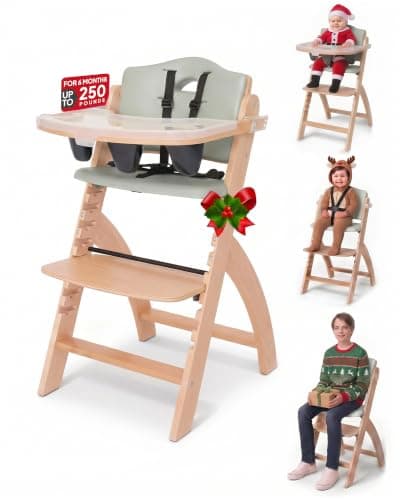
The chairs with the longest runway tend to be wooden, because a slotted hardwood frame is strong enough to be rated for adult use — the Abiie Beyond Junior is rated from six months to 250lb, for instance. If longevity is what you are buying, that is the spec to compare, and the best wooden high chairs lines them up side by side.
What to check before you buy
- Is the limit well above where your child is now? If it is within ten pounds, you are buying this again next year.
- Is there a height limit as well? Many chairs have both, and children frequently hit the height limit first. A child whose shoulders are above the top harness slot has outgrown the restraint regardless of weight.
- Does the number change by stage? On a convertible, ask which number applies to the configuration you will actually use first.
- Does the harness still adjust at that weight? A limit is irrelevant if the straps stop fitting before you get there.
- For a hook-on seat, what can your table take? The seat's limit and your table's limit are different numbers, and the table is often the weaker one — see the best hook-on high chairs.
What to do when you are close to the limit
Move, do not stretch. The usual next step is a booster seat strapped to a dining chair, which the CPSC defines for children up to five years of age — so one purchase covers the rest of the stage, costs little, takes no floor space and travels. Our high chair vs booster seat page covers the handover and when to stop using a high chair covers the timing.
If you own a convertible, you may need to buy nothing at all: removing the tray and the infant insert and moving the seat and footplate often converts the same frame into a youth chair with a much higher limit. That is the argument for having bought a convertible in the first place.
And if the reason you are reading this is that your toddler is climbing rather than growing, weight is not the issue — restraint use is. A tray that touches the child is not a harness, which is covered properly in does a high chair tray replace the harness.
Worth saying plainly
Never use a high chair, booster or hook-on seat past its stated weight or height limit, and never modify a seat to extend its life. Use the harness including the crotch strap every time, per AAP guidance, and never let a child stand in the chair. Check any second-hand seat against CPSC recalls and do not use one whose limit you cannot establish. We are not clinicians, and nothing here is medical advice.
What we would buy
Now that the decision is made, these are the products we would actually put in the basket, and why.
Product photo from the Amazon listing, not a photograph of our own unit.
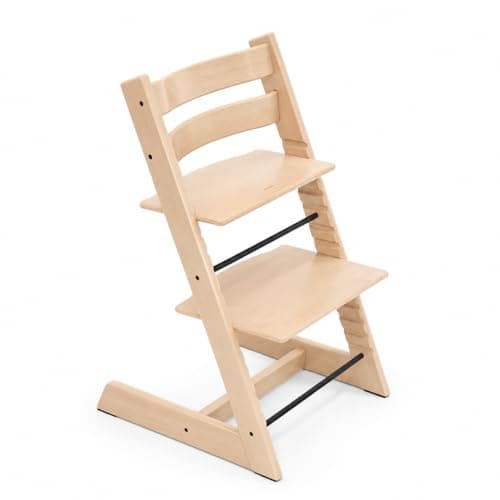
Stokke Tripp Trapp
Stokke
Buy it once. With the baby set it is a high chair, and the same frame is still a chair your teenager sits in.
- Safety
- 9
- Cleaning
- 7
- Footprint
- 9
- Longevity
- 10
- Value
- 7
- Type:
- Wooden, adjustable, grows with the child
- Footprint:
- Small, pulls up to the table
- Tray:
- None by default, the child eats at the table
- Price tier:
- Premium
What works
- Genuinely lasts into adulthood, which changes the cost calculation
- Seat and footplate adjust, so posture stays right as the child grows
- No tray means the child eats with the family from the first meal
What to know first
- The baby set and harness are separate purchases
- Wood needs wiping, not hosing
- Highest up-front price here
#ad Affiliate link · Price as of October 17, 2026
Product photo from the Amazon listing, not a photograph of our own unit.
Abiie Beyond Junior
Abiie
A wooden chair whose seat and footplate both slide to fit, rated to 250lb, and unlike the Tripp Trapp it comes with a tray in the box.
- Safety
- 9
- Cleaning
- 8
- Footprint
- 8
- Longevity
- 10
- Value
- 7
- Type:
- Wooden adjustable chair, grows with the child
- Footrest:
- Adjustable, independently of the seat
- Rated to:
- 6 months to 250lb
- Price tier:
- Premium
What works
- Seat and footplate adjust separately, so the bracing height is actually right
- Tray included, which the obvious competitor charges extra for
- Water-resistant finish, so spills are a wipe rather than a stain
What to know first
- Premium price, even on sale
- Wood needs wiping rather than hosing
- Assembly and readjustment take a few minutes each time
#ad Affiliate link · Price as of October 17, 2026
Product photo from the Amazon listing, not a photograph of our own unit.
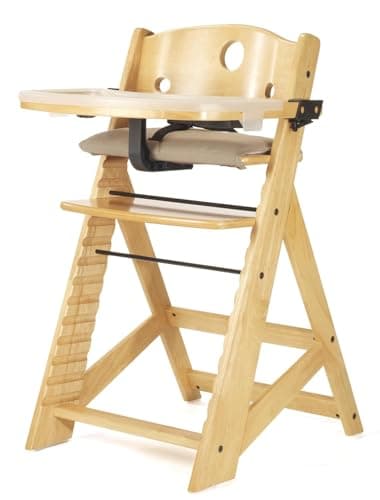
Keekaroo Height Right High Chair
Keekaroo
The footplate moves across a wider span than anything else here, which is the whole point if you want feet braced at every stage.
- Safety
- 9
- Cleaning
- 8
- Footprint
- 8
- Longevity
- 9
- Value
- 6
- Type:
- Wooden adjustable chair
- Footrest:
- Adjusts across roughly 4 to 21 inches from the floor
- Seat height:
- Roughly 16 to 24 inches
- Price tier:
- Premium
What works
- The largest footrest adjustment range in the category
- Plant-based lacquer finish, wipes clean with soapy water
- Becomes an ordinary chair at a table once the tray goes
What to know first
- The infant insert is a separate, pricier version
- Tray is an add-on on some configurations
- Premium money for a chair with no recline
#ad Affiliate link · Price as of October 17, 2026
Product photo from the Amazon listing, not a photograph of our own unit.
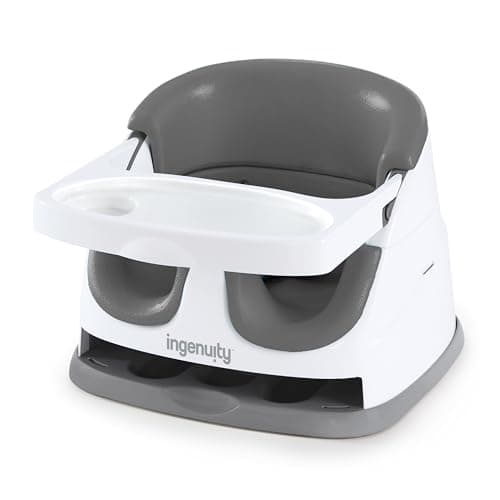
Ingenuity Baby Base 2-in-1 Booster
Ingenuity
The straightforward step after a high chair: it straps to a dining chair, has a removable tray, and wipes clean in seconds.
- Safety
- 7
- Cleaning
- 10
- Footprint
- 9
- Longevity
- 6
- Value
- 10
- Type:
- Floor seat and dining-chair booster
- Footprint:
- None, it sits on a chair
- Tray:
- Removable, dishwasher-safe
- Price tier:
- Budget
What works
- Doubles as a floor seat for first tastes
- Hard plastic wipes clean instantly
- Cheap and widely available
What to know first
- Needs a dining chair with a flat seat
- Less support than a proper high chair for a young baby
- No height adjustment
#ad Affiliate link · Price as of October 17, 2026
Common questions
What is the weight limit on a high chair?
There is no single figure — it varies enormously between a moulded plastic seat and a wooden convertible, and convertibles have a different limit for each stage. Find your own model's number on the label under the seat, in the manual, or on the maker's own product page, and treat it as a hard stop.
What happens if a child is over the high chair weight limit?
The chair's stability and structural testing no longer covers your situation, so tipping and joint failure become real risks rather than theoretical ones. Move to a booster seat on a dining chair instead — the CPSC defines boosters for children up to five years old.
How long can a child use a high chair?
The CPSC defines a high chair as a freestanding chair for a child up to three years of age, but the operative number is your own model's stated weight and height limit. A wooden convertible rated to 250lb can keep going long past three; a small plastic seat may not reach it.
Do high chairs have a height limit too?
Many do, and children often hit it before the weight limit. The practical test is the harness: if your child's shoulders sit above the highest harness slot, the restraint no longer fits properly and the seat has been outgrown whatever the scales say.
Why does my convertible high chair have three different weight limits?
Because each configuration is structurally a different chair. A raised seat on a narrow base is a stability problem; the same seat strapped to a dining chair transfers the load to that chair; at its lowest setting it is effectively a stool. The limit that applies is the one for the stage you are using.
Can I use a hook-on high chair if my child is under its limit?
Only if your table is also rated for it. Clamp-on seats transfer the child's whole weight into the tabletop, so the limiting factor is often the table rather than the seat. Never clamp one to a glass, pedestal, trestle or loose-topped table.
Sources
- CPSC — High Chairs (16 CFR part 1231, ASTM F404)
- CPSC — Booster Seats (16 CFR part 1237, ASTM F2640)
- American Academy of Pediatrics (HealthyChildren.org) — High Chair Safety Tips
- CPSC — Recalls
- Lalo — The Chair II, 7-in-1 convertible wooden high chair specification
- Stokke — Tripp Trapp High Chair (chair, baby set and harness) specification