Guides
Does a tight high chair tray replace the harness?
No. This comes up in food-safety and childcare exams as a true/false question, and the answer is false. Here is why, in the clearest terms we can manage.
How this page is funded: if you buy through a link here we may earn an Amazon commission, at no extra cost to you. It never changes which product we put first, and we recommend the cheaper option whenever it is the better one. Full disclosure.
The short answer
False. A high chair tray is never a substitute for restraints, however tightly it fits. A tray holds food; it is not attached to the child, and a child who can push off the footrest can stand up over it, slide down beneath it, or tip the whole chair using it as leverage. The American Academy of Pediatrics is explicit that a high chair's safety straps — including the strap between the legs — must be used every time, and that the tray must not be relied on to keep a child in the seat. If your chair has lost its straps, replace them from the manufacturer before using the chair again. A chair without a working harness is not a usable high chair.
Why the tray cannot do the harness's job
The confusion is understandable. A locked tray sits against a child's middle and feels like it is holding them in. Three things break that intuition.
It is attached to the chair, not the child. A harness holds the child to the seat. A tray holds the gap in front of them. There is nothing stopping a child from standing up, and a tray against the thighs becomes a pivot the moment they do.
Children slide down, not just up. Without a crotch strap, a child can slip forward and down so their body goes under the tray while their head does not. That is the mechanism behind some of the most serious high chair injuries, and it is the specific reason the strap between the legs exists.
A tray gives leverage. A toddler who braces against a locked tray can push a freestanding chair backwards. Trays are designed to come off, which also means they are designed to release under load in a way a five-point harness is not.
| The claim | True or false | Why |
|---|---|---|
| A tray that fits tightly against the child replaces the restraints | False | A child can stand up over a tray; the tray is not anchored to the child |
| Shoulder straps alone are enough | False | Without a crotch strap a child can slide down and under — submarining |
| A crotch post in the seat replaces the crotch strap | False | It stops sliding forward, not standing up. It is a complement, not a substitute |
| Restraints are only needed for babies who cannot sit well | False | The climbing toddler is the one most likely to fall from the seat |
| You can skip the harness for a quick snack | False | Falls happen in seconds, usually while an adult is briefly out of reach |
The AAP's high chair safety guidance is the plainest source on this: use the safety straps every time, do not rely on the tray, never let a child stand in the chair, and keep the chair away from walls and counters a child can push off.
What a correctly used harness looks like
- Crotch strap first, every time. It is the one that stops sliding under. If the chair has only a waist belt and no crotch strap, the seat is not safe for a child who can move much.
- Shoulder straps at or just below shoulder height. Too high and they slip off; too low and they push the child forward. Most chairs have two or three slot positions.
- Two fingers of slack, no more. You should be able to slide two fingers flat between the strap and your child's chest. Any more and the harness is decorative.
- Buckled before the tray goes on. Doing it in the other order makes the crotch strap awkward to reach, which is how it quietly stops being used.
- Checked for wear. Webbing frays, buckles crack, and both happen gradually. Look at them properly once a month.
- Used for the whole meal. Including the part where they have finished and you are clearing up, which is exactly when most falls happen.
Replacing lost or broken straps
Straps get removed for washing and never come back, and second-hand chairs often arrive without them. Both are common and both have the same answer.
Buy the manufacturer's replacement part for your exact model. Nearly every maker sells harnesses and buckles as spares, often cheaply. The anchor points, webbing width and buckle type are model-specific, and a generic strap that does not anchor correctly is worse than useless because it looks like protection.
Do not improvise. Luggage straps, scarves and cable ties are not restraints, and anything that can tighten around a torso or a neck introduces a new hazard. If you cannot source a correct harness, stop using the chair.
For a second-hand chair, check recalls first. Harness and buckle failures are one of the commonest reasons high chairs are recalled, so check the model against CPSC recalls before buying parts for it. The rest of the used-chair checks are in the high chair safety checklist.
What the standard actually requires
High chairs sold in the US are covered by the CPSC's high chair rule, which incorporates ASTM F404 and defines a high chair as a freestanding chair for a child up to three years of age. The standard covers restraint systems as well as stability and structure — that is, the harness is part of what the chair was certified with, not an accessory bundled on top. Using the chair without it is using a different product from the one that was tested.
The related number worth knowing is the chair's stated weight and height limit, which is covered in high chair weight limits. A harness that no longer adjusts to fit is itself a signal the seat has been outgrown, whatever the scales say — see when to stop using a high chair.
If buckling has become a daily fight
That is a signal about the seat, not a reason to skip the buckle. Three things help: lower the footplate so there is less to push off, move the chair away from the table and the wall so there is nothing to brace against, and stop negotiating about the strap — it goes on the same way every meal.
If it is still a fight, the usual answer is to move them to a strapped booster at the family table. A seat a toddler will sit in beats a seat they escape from, and the handover is covered in high chair vs booster seat and the best high chairs for toddlers.
Worth saying plainly
Use the safety straps, including the strap between the legs, every single time, and never substitute the tray for the harness — that is AAP guidance. Never let a child stand in a high chair, never leave a child unattended in one, and keep the chair away from walls and counters they can push against. Do not use a chair whose harness is missing, frayed or broken until you have fitted the manufacturer's replacement part. Check second-hand chairs against CPSC recalls. We are not clinicians, and nothing here is medical advice.
What we would buy
Now that the decision is made, these are the products we would actually put in the basket, and why.
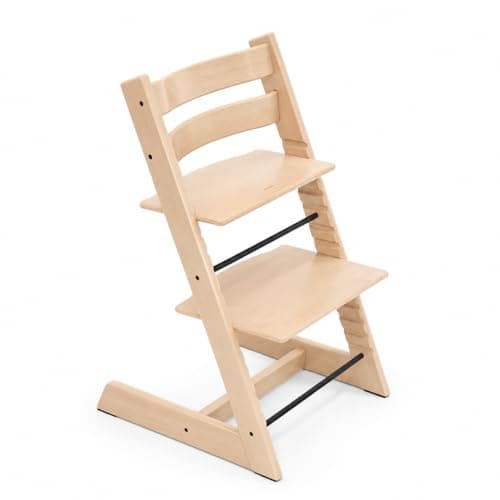
Product photo from the Amazon listing, not a photograph of our own unit.
Stokke Tripp Trapp
Stokke
Buy it once. With the baby set it is a high chair, and the same frame is still a chair your teenager sits in.
- Safety
- 9
- Cleaning
- 7
- Footprint
- 9
- Longevity
- 10
- Value
- 7
- Type:
- Wooden, adjustable, grows with the child
- Footprint:
- Small, pulls up to the table
- Tray:
- None by default, the child eats at the table
- Price tier:
- Premium
What works
- Genuinely lasts into adulthood, which changes the cost calculation
- Seat and footplate adjust, so posture stays right as the child grows
- No tray means the child eats with the family from the first meal
What to know first
- The baby set and harness are separate purchases
- Wood needs wiping, not hosing
- Highest up-front price here
#ad Affiliate link · Price as of October 17, 2026
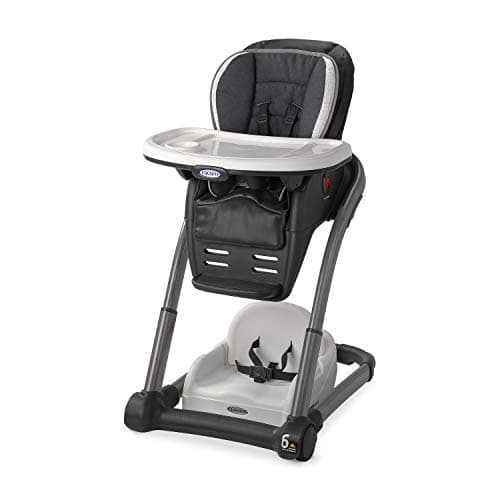
Product photo from the Amazon listing, not a photograph of our own unit.
Graco Blossom 6-in-1
Graco
Converts through six configurations from infant high chair to toddler booster to youth stool. The most modes for the money.
- Safety
- 8
- Cleaning
- 6
- Footprint
- 5
- Longevity
- 9
- Value
- 9
- Type:
- Convertible, six modes
- Footprint:
- Large
- Tray:
- Removable, dishwasher-safe insert
- Price tier:
- Mid-range
What works
- Covers infant through school age without another purchase
- Tray insert goes in the dishwasher
- Recline is genuinely useful for a young baby
What to know first
- Bulky, with the biggest floor footprint here
- The fabric seat pad catches crumbs in every seam
- Lots of parts to store when unused
#ad Affiliate link · Price as of October 17, 2026
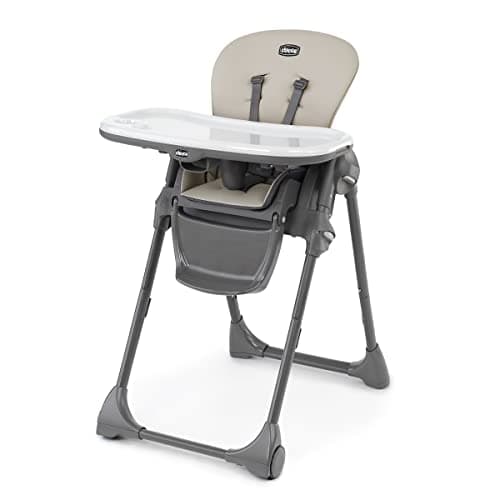
Product photo from the Amazon listing, not a photograph of our own unit.
Chicco Polly
Chicco
Rubberised wheels, seven heights, a three-position recline and a tandem footrest, in a chair that folds to eleven inches wide.
- Safety
- 8
- Cleaning
- 7
- Footprint
- 7
- Longevity
- 7
- Value
- 9
- Type:
- Folding full-size chair on wheels
- Recline:
- Three positions
- Wheels:
- Rubberised, non-marking
- Price tier:
- Mid-range
What works
- Rolls up to almost any table without lifting it
- Folds to eleven inches wide, which is rare in a wheeled chair
- Seven heights and a footrest at a mid-range price
What to know first
- Fabric-faced seat pad, so spills need wiping properly
- Weight limit of 40 pounds, lower than convertibles
- Fold-away armrests add a step when you put it away
#ad Affiliate link · Price as of October 17, 2026
Common questions
If the high chair tray fits tightly against the child, are restraints still required? True or false?
False. A tray is never a substitute for restraints, however tightly it fits. It is attached to the chair rather than to the child, so a child can stand up over it or slide down underneath it. AAP guidance is to use the safety straps, including the crotch strap, every time.
Do you have to use the straps on a high chair?
Yes, every time, for every meal and snack. The restraint system is part of what the chair was tested and certified with under the CPSC high chair rule, not an optional accessory. The most serious high chair injuries involve falls from an unrestrained seat.
Why does a high chair need a crotch strap?
To stop a child sliding forward and down so their body passes under the tray while their head does not. Shoulder straps alone do not prevent that, which is why a waist belt with no crotch strap is not an adequate restraint for a child who can move.
Where can I get replacement high chair straps?
From the manufacturer, for your exact model — nearly all of them sell harnesses and buckles as spare parts. Anchor points, webbing width and buckle type are model-specific, so do not fit a generic strap, and never improvise with luggage straps or anything that can tighten.
Is a crotch post the same as a crotch strap?
No. A moulded post in the seat stops a child sliding forward, but it does nothing to stop them standing up. It complements a harness rather than replacing one. Chairs that have a post still ship with a strap for exactly that reason.
Can I use a high chair without a harness if I never leave the room?
No. Falls happen in seconds and usually while an adult is nearby but briefly out of reach — turning to the sink, answering the door. Supervision and restraint do different jobs, and the guidance asks for both.