Baby bottles
Dr. Brown's vs Philips Avent: which bottle should you buy?
A vent you wash against a valve you do not. That single difference decides this, and for most babies it decides it in Avent's favor.
How this page is funded: if you buy through a link here we may earn an Amazon commission, at no extra cost to you. It never changes which product we put first, and we recommend the cheaper option whenever it is the better one. Full disclosure.
The short answer
Buy the Philips Avent Natural Response as your first bottle. It is three parts instead of five, its nipple only releases milk while the baby is actively drinking, and it has the largest parts ecosystem in the category — so a bottle that half-works can be adjusted with a different nipple instead of replaced. Buy Dr. Brown's Anti-Colic Options+ Narrow if you already have a genuinely gassy baby — its internal vent is the one in this category with the deepest published evidence behind it, and the vent lifts out later once the gas settles, which means Dr. Brown's is also the better buy if you want the option of both.
Quick picks
Our ranking, with the reasoning underneath. Tap any row to jump to the full write-up.
| # | Product | Best for | Score | Price |
|---|---|---|---|---|
| 1 | 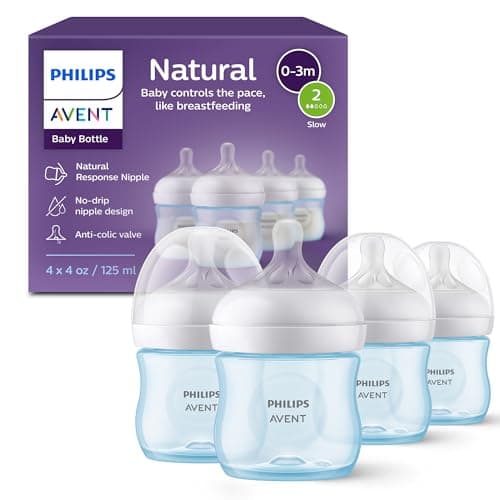 Philips Avent Natural Bottle with Natural Response Nipple The safest default buy: a wide nipple that only releases milk when the baby actively drinks, inside the biggest parts ecosystem on the shelf. | Most babies | 8.9 | $26.12$30.99(16% off)View on Amazon #ad Affiliate link · Price as of October 22, 2026 |
| 2 | 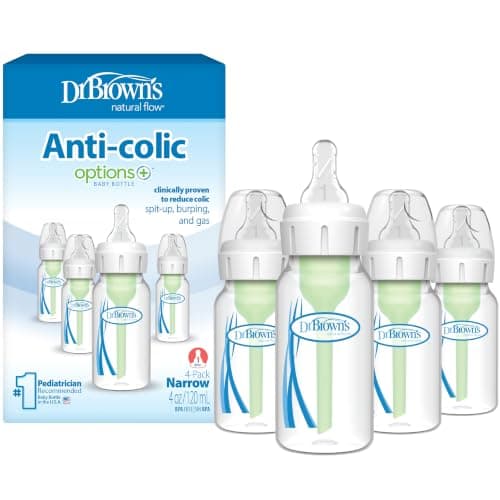 Dr. Brown's Anti-Colic Options+ Narrow The anti-colic bottle with the deepest clinical backing. The internal vent genuinely reduces wind, and genuinely adds parts to wash. | Gas and colic | 8.6 | $23.96View on Amazon #ad Affiliate link · Price as of October 22, 2026 |
| 3 | 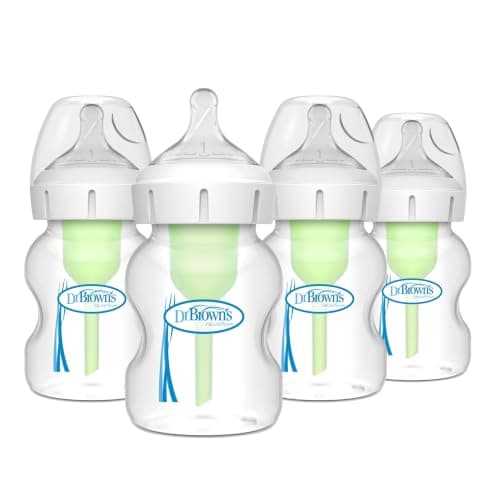 Dr. Brown's Anti-Colic Options+ Wide-Neck Dr. Brown's venting behind a wide, breast-shaped nipple. The compromise pick when your baby is gassy and nursing. | A gassy breastfed baby | 8.7 | $24.99View on Amazon #ad Affiliate link · Price as of October 22, 2026 |
Scores are our own research scores on the rubric published at how we choose. They are not star ratings from customers, and we do not show a price we cannot verify live.
Side by side
| What matters | Dr. Brown's Anti-Colic Options+ Narrow | Philips Avent Natural Response |
|---|---|---|
| How air is kept out of the milk | An internal vent tube routes air past the milk to the back of the bottle, so the milk is not aerated | A vented nipple collar. Air goes in around the rim rather than through a tube |
| How milk comes out | Conventional — flow follows the baby's suction | A valve in the nipple tip opens only while the baby actively drinks, so a pause stops the flow |
| Nipple shape | Narrow (a wide-neck version exists, below) | Wide |
| Parts to wash per bottle | Five with the vent in, three with it out | Three |
| Can you simplify it later? | Yes — the maker says the vent can come out as feeding develops, with no change of bottle | Nothing to remove; it is already three parts |
| Flow levels | Preemie and Ultra-Preemie upward, which Avent has no equivalent of | Five published flow levels, newborn through toddler |
| Bodies available | Polypropylene and glass | Polypropylene, glass and PPSU, one nipple range across all three |
| Accessory ecosystem | Good — nipples, sippy conversions, formula pitchers | The largest on the US shelf — nipples, sippy tops and Philips pump parts interchange |
| Fits a narrow warmer well | Yes, the narrow version does | No, the wide base needs a wide well |
| Price tier | Mid-range | Mid-range |
Two rows decide this page. The first is parts to wash: five against three, every bottle, every day, for a year. The second is how milk comes out: Dr. Brown's flows when the baby sucks, Avent flows only while the baby is actively drinking. Everything else here is close enough that it will not change your mind at 3am.
The vent: what Dr. Brown's actually buys you
Dr. Brown's whole argument is a tube. Air entering the bottle is routed through an internal vent past the milk to the back of the bottle, so the milk is not aerated and there is no vacuum building against the nipple as the bottle empties. The maker's own specification page describes exactly that, and the result parents report is less swallowed air, less burping and less mid-feed squirming.
Two honest qualifications. First, "less air in the milk" is a plumbing claim, not a cure: a baby crying inconsolably every evening is not necessarily a baby with a bottle problem, and swapping bottles will not fix colic that has another cause. Second, no vent helps if the baby is gulping because the flow rate is wrong for them — that is a nipple problem, covered in bottle nipple flow sizes.
The underrated part of the Dr. Brown's design is that it is reversible. The maker states the bottle works best with the vent in place but that it can be removed as feeding develops, with no need to introduce a different bottle. That is a real feature: you can start at five parts while the baby is windy and drop to three parts when they are not, without buying a second set of bottles. Nothing in the Avent range does the same thing in the other direction.
The nipple: Avent's valve is the quieter innovation
Avent's Natural Response nipple has a valve in the tip. Milk is released only while the baby is actively drinking; when they stop to breathe or rest, the flow stops with them. Philips publishes the full flow-level range — five levels from newborn upward, all fitting the same bottles.
This matters more than it sounds for two groups. A baby who moves between breast and bottle gets a feed that behaves a little more like nursing, because pausing actually pauses it. And a baby who chokes or sputters on a fast bottle gets a flow that interrupts itself rather than one that keeps pouring. It is the same effect paced bottle feeding is trying to achieve by technique, built into the part.
The cost is that the valve can read as "slow" to a hungry baby and to a first-time parent watching the clock. If feeds are dragging, the answer is to move up a flow level, not to abandon the system — which is exactly why that published five-level ladder is worth something.
Parts to wash: the difference you feel every day
Five parts against three, six to eight times a day, is the most underweighted fact in this comparison. Over a week it is the difference between roughly a hundred small items in the drying rack and roughly sixty. The vent tube and reservoir also need a brush, not a wipe, and a vent assembled slightly wrong is the single most common cause of the leaks Dr. Brown's gets blamed for — typically from over-tightening or over-filling.
If you have a dishwasher with a heated dry or sanitize cycle, this gap narrows a lot. If you are hand-washing in a small kitchen, it is the deciding factor for most people. Our how to wash baby bottles guide covers the basket-and-brush routine that makes a five-part bottle survivable.
The third option almost nobody considers
Dr. Brown's Anti-Colic Options+ also comes in a wide-neck version, and it is the obvious answer to the most common objection to Dr. Brown's: that a baby used to a wide, breast-shaped nipple will not take a narrow one. The wide-neck bottle has the same internal vent and the same remove-it-later behavior, in a bottle shape closer to the Avent.
The trade is cleaning again. A wide neck is easier to get a hand or a brush into, but the wide bottle will not fit a narrow bottle-warmer well, and it takes more cupboard space. If you want the vent and you want a wide nipple, this is the pick; if neither shape is settled yet, buying one of each and seeing which the baby prefers is a legitimate and cheap experiment, and it is what how many bottles do I need recommends before you commit to a set of six.
If you are mixing breast and bottle
Lean Avent. The flow-on-demand valve is the closest thing on the shelf to a nipple that respects a baby's own pauses, and a wide nipple is the easier shape for a breastfed baby to transfer onto. The same logic drives our best bottles for breastfed babies ranking.
There is a second, unglamorous reason: if you pump with a Philips pump, the bottles and collars interchange with the pump's, so you pump into the bottle you feed from and wash one set of parts instead of two. That is a real daily saving and it is the kind of thing nobody tells first-time buyers.
If your baby was born early or has a weak suck
This is the one scenario where Dr. Brown's wins outright, and it is not about the vent. Dr. Brown's publishes a Preemie and Ultra-Preemie flow at the bottom of its nipple ladder; Avent's published range starts at a standard newborn level. If your baby needs a slower-than-newborn flow, there is simply more range available. We go into the whole set in best bottles for preemies.
Which one to buy
Buy the Avent Natural Response if you are buying a first bottle and nothing has gone wrong yet. Three parts, a nipple that paces the feed for you, five flow levels, plastic, glass and PPSU bodies on one nipple range, and the biggest accessory shelf in the category. It is the lowest-regret purchase here.
Buy Dr. Brown's Anti-Colic Options+ Narrow if the baby is already gassy, grunting through feeds, or spitting up more than seems normal, and you want the most-evidenced venting design on the shelf — accepting two extra parts per wash for as long as you need it. You can take the vent out later, which no other system here offers.
Buy Dr. Brown's Anti-Colic Options+ Wide-Neck if you want that vent but the baby has already refused a narrow nipple. Same vent, wider shape, slightly worse at fitting warmers.
Both ranges are mid-range on price and both are cheap relative to a year of formula, so price should not decide this. If you want the two systems placed against the rest of the field, that is the best baby bottles, and if gas is your actual problem rather than your suspected one, start with the best anti-colic bottles.
Worth saying plainly
Clean every part after every feed and follow the CDC's cleaning and sanitizing guidance for feeding items — a five-part bottle has more places for milk residue to sit, so the vent tube and reservoir need a brush rather than a rinse. Never enlarge a nipple hole to speed a feed up, and never prop a bottle. Persistent spit-up, back-arching, poor weight gain or distress at every feed is a conversation with your pediatrician, not a bottle purchase — see AAP guidance on spitting up. We are not clinicians, and nothing here is medical advice.
How we chose
Researched, not hands-on, and we say so on every card. Vent behavior, the remove-the-vent claim and the flow ladders come from the makers' own specification pages — Dr. Brown's and Philips Avent. Independent hands-on testing of the wider bottle field comes from Mommyhood101. Cleaning and sanitizing requirements are the CDC's, and the spit-up context is the AAP's. On this page daily cleaning load and nipple-flow range are weighted heaviest, because those are the two things a first-time buyer cannot judge in a store. Full rubric: how we choose.
What we would buy
Now that the decision is made, these are the products we would actually put in the basket, and why.
Product photo from the Amazon listing, not a photograph of our own unit.
Philips Avent Natural Bottle with Natural Response Nipple
Philips Avent
The safest default buy: a wide nipple that only releases milk when the baby actively drinks, inside the biggest parts ecosystem on the shelf.
- Latch
- 9
- Colic control
- 8
- Cleaning
- 9
- Durability
- 9
- Value
- 9
- Material:
- Polypropylene, glass and PPSU versions
- Parts to wash:
- Three
- Nipple shape:
- Wide
- Price tier:
- Mid-range
What works
- Flow-on-demand nipple paces the feed more like nursing
- Bottles, nipples, sippy tops and pump parts all interchange
- Available in plastic, glass and PPSU with the same nipples
What to know first
- Venting is milder than Dr. Brown's for a severely windy baby
- Nipple flow numbering confuses first-time buyers
- Wide base does not fit narrow warmer wells
#ad Affiliate link · Price as of October 22, 2026
Product photo from the Amazon listing, not a photograph of our own unit.
Dr. Brown's Anti-Colic Options+ Narrow
Dr. Brown's
The anti-colic bottle with the deepest clinical backing. The internal vent genuinely reduces wind, and genuinely adds parts to wash.
- Latch
- 8
- Colic control
- 10
- Cleaning
- 5
- Durability
- 9
- Value
- 8
- Material:
- Polypropylene, glass version available
- Parts to wash:
- Five with the vent, three without
- Nipple shape:
- Narrow
- Price tier:
- Mid-range
What works
- The vent system has the strongest evidence base for reducing gas
- Vent is removable once colic settles, cutting cleaning to three parts
- Nipple flow levels run from preemie upward
What to know first
- Most parts to wash of any bottle here
- The vent can leak if the bottle is over-tightened or over-filled
- Narrow neck makes hand-washing fiddlier
#ad Affiliate link · Price as of October 22, 2026
Product photo from the Amazon listing, not a photograph of our own unit.
Dr. Brown's Anti-Colic Options+ Wide-Neck
Dr. Brown's
Dr. Brown's venting behind a wide, breast-shaped nipple. The compromise pick when your baby is gassy and nursing.
- Latch
- 9
- Colic control
- 10
- Cleaning
- 6
- Durability
- 9
- Value
- 8
- Material:
- Polypropylene, glass version available
- Parts to wash:
- Five with the vent fitted
- Nipple shape:
- Wide
- Price tier:
- Mid-range
What works
- Wide nipple is easier for a nursing baby to accept than the narrow version
- Same vent system as the narrow Options+
- Easier to hand-wash than the narrow neck
What to know first
- Still five parts with the vent in
- Bulkier in a diaper bag
- Wide bottles fit fewer warmer wells
#ad Affiliate link · Price as of October 22, 2026
Common questions
Is Dr. Brown's or Philips Avent better?
For a first bottle, Philips Avent Natural Response: three parts instead of five, a nipple that releases milk only while the baby is actively drinking, and the largest accessory range in the category. Dr. Brown's Anti-Colic Options+ is the better buy for a baby who is already visibly gassy, because its internal vent is the most-evidenced venting design on the shelf.
Do Dr. Brown's bottles really help with gas?
The mechanism is real and the maker documents it: air is routed through an internal vent past the milk, so the milk is not aerated and no vacuum builds against the nipple. Whether it helps your baby depends on whether swallowed air is actually their problem. If the baby gulps and chokes, the flow level is more likely the issue than the venting.
Can you use Dr. Brown's bottles without the vent?
Yes, and that is one of the best things about them. Dr. Brown's states the bottle works best with the vent in place but that it can be removed as feeding develops, with no need to switch to a different bottle. Taking it out drops the bottle from five parts to three.
Are Philips Avent nipples slow?
The Natural Response nipple can feel slow because it only releases milk while the baby is actively drinking, which is the point of it. If feeds are dragging, move up the published flow ladder rather than changing bottle ranges — Philips lists five levels and they all fit the same bottles.
Do Dr. Brown's and Philips Avent parts fit each other?
No. Nipples, collars and caps are not interchangeable between the two ranges, and neither are the wide and narrow versions of Dr. Brown's. Pick a range before you buy six bottles, which is the argument in how many bottles do I need.
Which is easier to clean?
Philips Avent, clearly: three parts and a wide neck a brush fits into. Dr. Brown's with the vent in is five parts and the vent tube needs brushing rather than rinsing. A dishwasher with a heated dry cycle narrows the gap; hand-washing widens it.
Which one is better for a breastfed baby?
Avent, on balance — the wide nipple shape and the flow-on-demand valve both suit a baby moving between breast and bottle, and the bottles interchange with Philips pump parts. See best bottles for breastfed babies for the full ranking.
Sources
- Dr. Brown's — Natural Flow Anti-Colic Options+ Narrow bottle specification
- Philips Avent — Natural Response nipple range (five flow levels)
- Dr. Brown's — Narrow bottle nipple, Ultra-Preemie flow
- CDC — How to Clean, Sanitize, and Store Infant Feeding Items
- American Academy of Pediatrics (HealthyChildren.org) — Why Babies Spit Up
- Mommyhood101 — Best Baby Bottles, tested and reviewed