Guides
How many ounces should I pump?
Track the 24-hour total, not the session. Individual sessions swing wildly for reasons that have nothing to do with your supply, and the per-session number is the one that makes people panic.
How this page is funded: if you buy through a link here we may earn an Amazon commission, at no extra cost to you. It never changes which product we put first, and we recommend the cheaper option whenever it is the better one. Full disclosure.
The short answer
If you are exclusively pumping with an established supply, the figure to aim at is the whole-day total a baby typically drinks — broadly 24 to 32 ounces across 24 hours from about one month of age, divided across however many sessions you do. Per session that usually works out somewhere around 2 to 4 ounces combined from both breasts, but the per-session number swings enormously by time of day and means very little on its own. If you are pumping alongside nursing, expect far less — an ounce or two, often less — because your baby has already taken most of it. That is not a supply problem.
Why the daily total is the only honest number
Pump output is not a measurement of your supply. It is a measurement of how much milk a machine removed from you at one moment, and that depends on when you last fed or pumped, how relaxed you were, how well the flange fits, how old your valves are, and whether let-down happened at all. Any one of those can halve a session.
So the useful question is not "was that session enough" but "is the 24-hour total in the right region for what my baby needs". The AAP's how often and how much should your baby eat is the reference for the need side, and the formula-feeding equivalent with the per-pound arithmetic is in amount and schedule of formula feedings. Our how much milk should a newborn drink guide has the age-by-age version.
| Stage | What is normal, per session, both breasts | What it means |
|---|---|---|
| First 1–3 days | Drops to a few millilitres of colostrum | Entirely normal. Frequency matters, volume does not yet |
| Days 3–5, milk coming in | Rising fast, often unevenly | Output swings day to day. Do not read a trend into it |
| Weeks 2–6, exclusively pumping | Building toward a full daily supply | Total over 24 hours is the only number worth tracking |
| From ~1 month, established supply | Roughly 24–32oz across a whole day, split across sessions | This is a baby's typical daily intake, so it is the target to match |
| Pumping alongside nursing | Often an ounce or two per session, sometimes less | Your baby has already taken most of it. Not a supply problem |
Two things about that table are worth saying out loud. Breastfed babies' intake does not climb much after about the first month — a five-month-old does not drink twice what a two-month-old drinks — so the daily target is broadly stable, which makes it a useful anchor. And the ranges are wide because babies are different. A consistently content, growing baby with normal nappies is the real measure.
What changes output more than your pump does
- Flange fit. The single biggest controllable factor, and the most commonly wrong. Too big and you pull in areola that blocks flow; too small and it hurts and restricts the duct. Measure rather than guess — breast pump flange size has the method, and inserts fix most cases.
- Time of day. Most people pump their largest volumes in the early morning and their smallest in the late afternoon and evening. Comparing a 6am session to a 5pm session tells you nothing.
- Worn valves and membranes. Duckbills and membranes lose suction gradually, so output drifts down over weeks and feels like a supply problem. Replace them on a schedule — how often to replace breast pump parts.
- Let-down, not suction. Milk comes out when let-down happens, and let-down responds to warmth, relaxation and distraction — not to turning the dial up. Higher suction past your comfort level usually reduces output.
- Frequency. Production responds to removal. Dropping from eight sessions to six lowers the daily total within days, which is covered in how often should I pump.
- Hands. Breast compressions during the session, and hand expression for a minute afterwards, reliably add volume. This is free and it works better than most upgrades.
Getting more out of the pump you own
Start on massage or stimulation mode until let-down arrives, then switch to expression mode. Set suction to the highest level that is still completely comfortable, and no higher — comfort, not strength, is what correlates with removal. Pump for a couple of minutes past the last drops. And if you need a temporary boost, power pumping imitates cluster feeding for an hour a day, which is set out in how to power pump and in Spectra's own power pumping explainer.
The settings themselves are worth understanding properly rather than copying from someone else's routine, because cycle speed and vacuum do different jobs — breast pump settings explains both. And if a pump has simply stopped pulling, check that before you change anything else: breast pump not suctioning.
Numbers that look alarming and usually are not
Nothing in the first two days. Normal. Colostrum is measured in millilitres and sticks to equipment — the best breast pumps for colostrum explains why hands beat pumps at this stage.
One breast produces much more than the other. Very common and rarely significant.
Output drops around four months. Often a parts problem, sometimes a frequency problem, occasionally a period returning. Check valves first.
Half an ounce when you are nursing as well. Expected. The bottle is not measuring your supply, it is measuring the leftovers — the best breast pumps for combo feeding covers that pattern.
What is worth acting on: a sudden, sustained drop across several days with no equipment explanation, pain while pumping, or a baby who is not gaining weight or wetting enough nappies. Those are conversations with a lactation consultant or your pediatrician, not shopping problems.
Worth saying plainly
Pump output is not a diagnostic test and this page is not a growth chart. If your baby is not gaining weight, is not producing the expected number of wet nappies, or you have pain, bleeding or a sudden sustained drop in supply, speak to a lactation consultant, midwife or pediatrician. Never increase suction to the point of pain to chase a number. Store what you express per the CDC storage guidance and clean parts after every use per the CDC pump hygiene guidance. We are not clinicians, and nothing here is medical advice.
What we would buy
Now that the decision is made, these are the products we would actually put in the basket, and why.
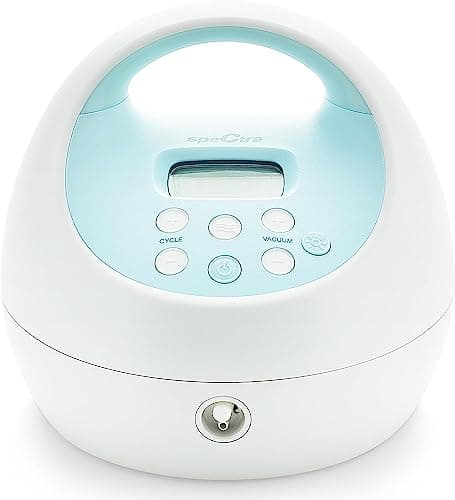
Product photo from the Amazon listing, not a photograph of our own unit.
Spectra S1 Plus
Spectra
The one to buy when output is the priority: gentle, quiet, genuinely adjustable, and it runs on a built-in battery so you are not chained to an outlet.
- Output
- 10
- Comfort
- 9
- Discretion
- 5
- Cleaning
- 8
- Value
- 8
- Type:
- Double electric, closed system
- Standout feature:
- Rechargeable battery and massage mode
- Cleaning burden:
- Low, closed system
- Price tier:
- Premium
What works
- Widely reported to produce more milk in less time than comparable pumps
- Separate cycle and suction controls, which is what beginners end up needing most
- Battery means you can pump anywhere in the house
What to know first
- Heavier than the S2, and far heavier than a wearable
- Tubing and flanges to wash
- You will want a hands-free pumping bra to use it comfortably
#ad Affiliate link · Price as of October 17, 2026
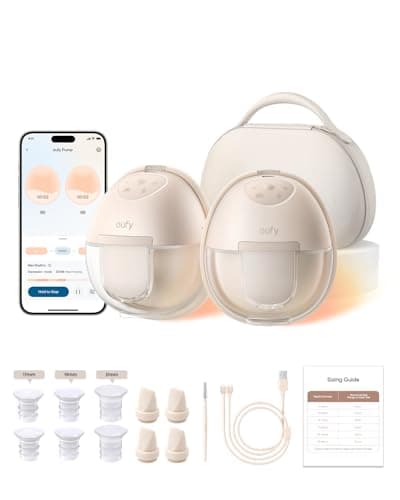
Product photo from the Amazon listing, not a photograph of our own unit.
eufy Wearable Breast Pump S1 Pro
eufy
The wearable that independent testers keep putting first: strong milk removal plus a gentle warming function that makes let-down easier at 3am.
- Output
- 9
- Comfort
- 9
- Discretion
- 8
- Cleaning
- 7
- Value
- 7
- Type:
- In-bra wearable cup, double
- Standout feature:
- Built-in warming
- Cleaning burden:
- Moderate, multi-part cups
- Price tier:
- Premium
What works
- Ranked first for milk removal among wearables by Consumer Reports and Forbes testers
- Warming helps let-down, which matters most on night pumps
- App control means you are not fishing inside your shirt to change settings
What to know first
- The most expensive way into wearable pumping
- More parts to wash than a simple collection cup
- Heavier in the bra than the slimmest wearables
#ad Affiliate link · Price as of October 17, 2026
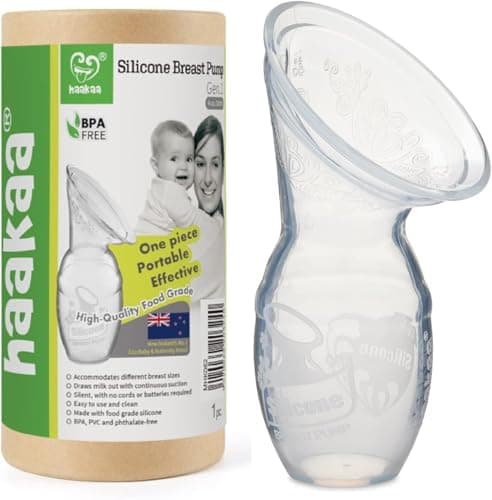
Product photo from the Amazon listing, not a photograph of our own unit.
Haakaa Silicone Breast Pump
Haakaa
Not really a pump: a one-piece silicone cup that catches the milk your other side leaks during a feed. Buy it as a second device, never your only one.
- Output
- 4
- Comfort
- 8
- Discretion
- 9
- Cleaning
- 10
- Value
- 10
- Type:
- One-piece silicone suction cup
- Standout feature:
- Nothing to assemble
- Cleaning burden:
- Very low, one piece
- Price tier:
- Budget
What works
- One piece, so washing takes seconds
- Catches milk that would otherwise soak into a nursing pad
- Cheap enough to own two
What to know first
- Suction is passive, so it cannot replace a real pump
- Tips over easily when full
- No suction control at all
#ad Affiliate link · Price as of October 17, 2026
Common questions
How many ounces should I pump per session?
With an established supply and exclusive pumping, somewhere around 2 to 4 ounces combined from both breasts is typical — but the figure swings widely by time of day and means little alone. Track the 24-hour total instead, which for most babies sits in the region of 24 to 32 ounces from about a month old.
How many ounces should I pump a day?
If you are exclusively pumping, aim at your baby's whole daily intake — broadly 24 to 32 ounces across 24 hours for most babies from about one month. Breastfed babies' daily intake stays fairly stable after the first month, so that target does not climb much as they grow.
Is 2 oz per pumping session normal?
Yes, very. Two ounces combined across both breasts is within the normal range for an established supply, and if you are also nursing it may be all there is left to take. Judge the system by your baby's growth and nappies rather than by the bottle markings.
Why am I pumping less than I used to?
Check the equipment before you worry about supply. Worn duckbill valves and membranes lose suction gradually and are the most common cause of a slow decline. After that: fewer sessions, a change in flange fit as your body changes, or a return of your period.
Does pumping longer get more milk?
A little — pumping a couple of minutes past the last drops is worth doing — but far less than pumping more often. Production responds to how frequently milk is removed. Adding a session usually beats extending one, and breast compressions during the session beat both.
Should both breasts produce the same amount?
No, and most people have a noticeably stronger side. A persistent difference is common and rarely significant on its own. If one side drops suddenly, check that the flange and valves on that side are not the problem before anything else.
Sources
- American Academy of Pediatrics (HealthyChildren.org) — How Often and How Much Should Your Baby Eat?
- American Academy of Pediatrics (HealthyChildren.org) — Amount and Schedule of Baby Formula Feedings
- CDC — Breast Milk Storage and Preparation
- CDC — How to Clean and Sanitize Breast Pumps
- Spectra Baby USA — What is Power Pumping?
- Aeroflow Breastpumps — Flange size chart and how to measure