Guides
How to dry baby bottles
Drying is not the boring end of washing up. It is the step that decides whether the wash counted, and the tea towel in your kitchen is the thing most likely to undo it.
How this page is funded: if you buy through a link here we may earn an Amazon commission, at no extra cost to you. It never changes which product we put first, and we recommend the cheaper option whenever it is the better one. Full disclosure.
The short answer
Air dry bottles and parts upright and uncovered on a clean, unused dish towel or a dedicated drying rack, and do not rub them dry with a tea towel — that re-contaminates what you just cleaned. Let them dry completely before you reassemble or store them, because assembling damp traps moisture inside the bottle, which is exactly what you are trying to avoid. Wash and dry the rack itself regularly; a permanently damp rack becomes the dirtiest object in the routine. A dishwasher with a heated-dry cycle does all of this for you, and a sterilizer-dryer is the only appliance that genuinely replaces a rack.
Why drying is a real step
Washing removes milk; drying removes the condition bacteria need to grow. The CDC guidance on cleaning, sanitizing and storing infant feeding items is specific about this: place items on a clean, unused dish towel or paper towel in an area protected from dirt and dust, allow them to air dry thoroughly, and do not use a dish towel to rub or pat items dry, because that can transfer germs onto them.
That last clause is the one worth reading twice. The tea towel hanging on your oven door has dried hands, plates and a worktop today. Putting it inside a clean bottle is the single most effective way to undo a careful wash and a sterilizing cycle in one motion.
| Method | How long | Re-contamination risk | Verdict |
|---|---|---|---|
| Air dry on a dedicated rack, uncovered | Several hours | Low, if the rack is clean and dry itself | The CDC method, and the default |
| Air dry on a clean, unused dish towel | Several hours | Low, if the towel is genuinely unused | Fine. Cheaper than a rack and easier to wash |
| Rub dry with a tea towel | Minutes | High | Do not. This undoes the wash |
| Dishwasher heated-dry cycle | Part of the cycle | Very low | Excellent, and it sanitizes at the same time |
| Sterilizer-dryer unit | Typically under an hour | Very low — sealed, filtered warm air | The only thing that genuinely replaces a rack |
| Standing bottles on a reused draining board | Hours | High | The commonest mistake in this list |
The method, step by step
- Separate everything. Bottle, nipple, collar, cap, vent insert. Nothing dries properly assembled, and trapped water is the whole problem.
- Shake the water out of the nipple. Squeeze it; the hole holds a surprising amount.
- Stand bottles upside down, so water runs out rather than pooling in the base. Small parts go in a basket or a pegged tray, not loose on a counter.
- Leave them uncovered, somewhere protected from dust and away from the sink splash zone. Covering them traps humidity.
- Let them dry completely before assembling. A bottle that is assembled damp and stored is a sealed humid container.
- Store assembled, in a clean dry cupboard, once everything is properly dry.
The wash that precedes all of this is in how to wash baby bottles, and the separate question of sanitizing is in how often to sterilize bottles. Drying matters in both routines, but it is most important after sanitizing, because a damp sterilized bottle is no longer sterile.
Is a drying rack worth buying?
A rack is a convenience, not a requirement — the CDC method works perfectly well with a clean, unused towel laid on a counter. What a rack buys you is vertical space, a place for small parts that does not involve hunting for a valve under the kettle, and a surface you can actually put in the dishwasher.
If you buy one, the things that matter are: pegs long enough to hold a bottle upside down without it touching the base tray, a removable drip tray you will genuinely empty, a small-parts basket, and a material and size that goes through your own dishwasher. A rack with a sealed base that collects a centimetre of standing water is worse than a towel.
And the thing nobody mentions: the rack needs washing too, weekly, and drying afterwards. A permanently damp plastic rack with a reservoir in the bottom is the dirtiest object in a bottle-washing routine, and it is sitting under everything you just cleaned.
When a sterilizer-dryer is the better buy
A sterilizer-dryer steams the parts and then runs warm filtered air over them in a closed chamber, so they come out dry, sanitized and ready to store without touching a counter at all. That removes the drying step rather than organising it, which is a genuinely different proposition from a rack.
It is worth the counter space and the money in three situations: no dishwasher; high volume, meaning eight or more bottles a day or daily pump parts; or a baby under two months, born prematurely, or with a weakened immune system, which per the CDC is the group for whom daily sanitizing actually matters. Outside those, a dishwasher with a heated-dry cycle does the same job for nothing.
The picks below are the three we would buy, and the full comparison is in the best bottle sterilizers, with the buy-or-not argument in do I need a bottle sterilizer and the dishwasher comparison in bottle sterilizer vs dishwasher.
Five drying mistakes
Rubbing dry with a tea towel. Covered above, and it is the big one.
Assembling while damp. Especially with silicone nipples, where water hides in the collar thread.
Drying on the ordinary draining board. Shared with dishes and rarely dried itself. Use something reserved for feeding items.
Covering the rack with a cloth to keep dust off. It traps humidity and slows drying to a crawl. Use a cupboard or a protected corner instead.
Never washing the rack. Weekly, in hot soapy water or the dishwasher, then dried. Put it in the calendar if you need to.
Worth saying plainly
Follow the CDC on cleaning, sanitizing, drying and storing feeding items, and its pump hygiene guidance for pump parts, which follow the same drying rules. Never rub feeding items dry with a dish towel. Do not store items damp or assembled while wet. If your baby is under two months old, was born prematurely, or has a weakened immune system, sanitizing daily is advised in addition to cleaning — talk to your pediatrician about your own situation. We are not clinicians, and nothing here is medical advice.
What we would buy
Now that the decision is made, these are the products we would actually put in the basket, and why.
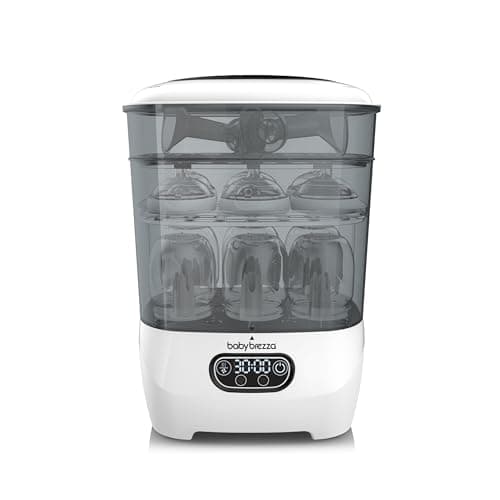
Product photo from the Amazon listing, not a photograph of our own unit.
Baby Brezza Bottle Sterilizer and Dryer Advanced
Baby Brezza
Sterilizes and dries a full load of bottles plus pump parts in one cycle, which is the only version of this job worth paying for.
- Speed
- 8
- Evenness
- 9
- Capacity
- 10
- Ease of use
- 8
- Value
- 7
- Method:
- Steam sterilize plus filtered dry
- Capacity:
- A day of bottles plus pump parts
- Extras:
- Sterile storage between cycles
- Price tier:
- Premium
What works
- Drying is the part that saves time, because wet parts are the daily annoyance
- Largest capacity in its class, so one cycle covers the day
- Keeps contents sterile between openings
What to know first
- Large, and it lives on the counter
- Premium price
- Needs regular descaling
#ad Affiliate link · Price as of October 17, 2026
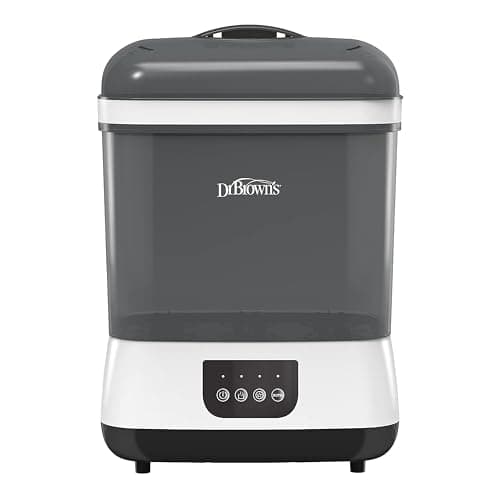
Product photo from the Amazon listing, not a photograph of our own unit.
Dr. Brown's All-in-One Sterilizer and Dryer
Dr. Brown's
The same sterilize-then-dry job as the Baby Brezza in a smaller, cheaper box. The one to buy if the Brezza is more machine than your counter can take.
- Speed
- 7
- Evenness
- 9
- Capacity
- 7
- Ease of use
- 8
- Value
- 9
- Method:
- Steam sterilize plus dry, in one cycle
- Takes:
- Bottles, bottle parts and other newborn essentials
- Extras:
- Sterilize-only and dry-only cycles
- Price tier:
- Mid-range
What works
- Smaller on the counter than the Baby Brezza
- Costs about half what the big machines do
- Handles pump parts and pacifiers, not just bottles
What to know first
- Smaller capacity than the Brezza, so a heavy pumping day needs two cycles
- The drying cycle is long
- Needs regular descaling, like every steam unit
#ad Affiliate link · Price as of October 17, 2026
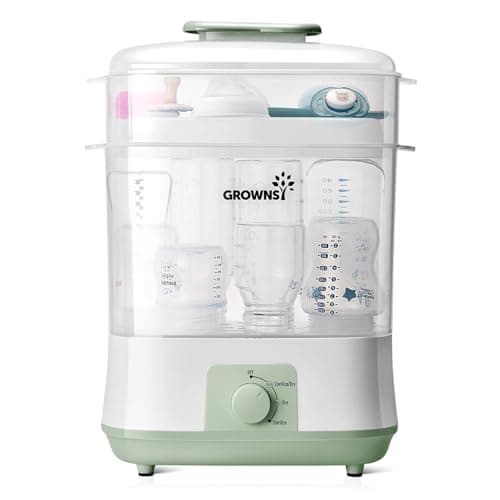
Product photo from the Amazon listing, not a photograph of our own unit.
Grownsy 4-in-1 Sterilizer and Dryer
Grownsy
Large capacity and long sterile storage for noticeably less money than the brand-name units.
- Speed
- 8
- Evenness
- 8
- Capacity
- 9
- Ease of use
- 7
- Value
- 9
- Method:
- Steam sterilize plus dry
- Capacity:
- Eight tall bottles
- Extras:
- Extended sterile-storage mode
- Price tier:
- Mid-range
What works
- Takes tall bottles that other units cannot
- Long sterile-storage window
- Much cheaper than the premium pair
What to know first
- Build quality is a step below the name brands
- Controls are less intuitive
- Support is thinner if something fails
#ad Affiliate link · Price as of October 17, 2026
Common questions
How should you dry baby bottles?
Air dry them upright and uncovered on a clean, unused dish towel or a dedicated drying rack, in a spot protected from dust. Do not rub or pat them dry with a tea towel — the CDC specifically warns that this can transfer germs onto items you have just cleaned.
Can you dry baby bottles with a towel?
You can lay them on a clean, unused towel to air dry. You should not rub them dry with one. The distinction matters: a towel that has dried hands or dishes today carries germs straight into a clean bottle.
Do you need a bottle drying rack?
No — a clean unused towel on the counter satisfies the guidance. A rack buys you vertical space, somewhere to put small parts, and a surface you can put through the dishwasher. If you buy one, pick one with a removable drip tray and wash the rack itself weekly.
How long do baby bottles take to air dry?
Several hours, which is why the number of bottles you own matters more than the drying method. Nipples and vent inserts take longest because water hides in the threads and the hole. A sterilizer-dryer typically gets there in under an hour.
Is it bad to store baby bottles assembled?
Only if they are damp. Assembling a wet bottle seals moisture inside it, which is the condition you spent the wash avoiding. Once everything is completely dry, assembling and storing in a clean dry cupboard is exactly what the CDC describes.
Is a sterilizer-dryer better than a drying rack?
It removes the drying step rather than organising it, which is worth real money if you have no dishwasher, are washing eight or more bottles a day, or have a baby under two months or born prematurely. Otherwise a dishwasher with a heated-dry cycle does the same job for nothing.