Guides
Baby bottle sizes by age
There are only two sizes that matter, 4oz and 8oz, and the changeover is around three to four months. Everything else is marketing.
How this page is funded: if you buy through a link here we may earn an Amazon commission, at no extra cost to you. It never changes which product we put first, and we recommend the cheaper option whenever it is the better one. Full disclosure.
The short answer
Buy 4oz (120ml) bottles for a newborn and switch to 8oz (240ml) bottles at around three to four months, when a feed routinely passes about four ounces. Those are the only two sizes most families need. A newborn takes a few millilitres at first, rising to roughly 2 to 3 ounces per feed in the first month and 4 to 6 ounces by three to six months; most babies settle at a total of roughly 24 to 32 ounces across a whole day from about a month old and do not climb much beyond it. Bottle size is not the same decision as nipple flow, and changing one does not mean changing the other.
Why only two sizes matter
Walk into any store and you will find bottles in five or six capacities. In practice there are two useful ones: a small bottle for the newborn period, around 4oz or 120ml, and a standard bottle for everything afterwards, around 8oz or 240ml. Some ranges sell a 9oz or 11oz version; those exist for marketing reasons and for toddlers who should be on a cup anyway.
The small bottle earns its place for three reasons. The graduations are easier to read accurately at two ounces on a small bottle than on a large one. A half-empty large bottle looks like a failed feed even when it was a normal one, and that matters more to new parents than anyone admits. And expressed milk left in a bottle has to be used within a short window, so overfilling means pouring milk away.
| Age | Bottle size to own | Typical amount per feed | Why |
|---|---|---|---|
| Newborn, 0–1 month | 4oz / 120ml | A few millilitres rising to 2–3oz | A small bottle is easier to read and wastes less milk |
| 1–3 months | 4oz, starting to add 8oz | Around 3–4oz | Feeds get bigger but 4oz still covers most of them |
| 3–6 months | 8oz / 240ml | Around 4–6oz | The point where small bottles start needing refills mid-feed |
| 6–12 months | 8oz, with a cup appearing at meals | Around 6–8oz, fewer feeds as solids start | Total daily intake stays broadly flat; feeds get bigger and rarer |
| 12 months + | Cups, not bottles | n/a | Bottles should be on the way out by about eighteen months |
One detail worth knowing: breastfed babies' daily intake stays remarkably flat after about the first month. A six-month-old does not drink twice what a two-month-old drinks — the feeds get bigger and less frequent, but the daily total holds. The AAP's how often and how much should your baby eat covers that pattern, and the formula arithmetic, which is weight-based, is in amount and schedule of formula feedings.
Bottle size is not nipple flow
This is the most common confusion in the category, and it is worth separating completely. The bottle is a container; the nipple decides how fast milk comes out. They are usually packaged together, which is why moving to an 8oz bottle often silently moves a baby to a faster nipple as well.
Do not let that happen by accident. A baby who is feeding happily on a slow flow should stay on a slow flow when the bottle gets bigger — buy the large bottle and move the existing nipple across. Signs a flow is too fast include gulping, milk escaping at the corners of the mouth, and finishing a bottle suspiciously quickly. The full ladder is in bottle nipple flow sizes, and the picks are in the best bottle nipples.
How many of each to buy
For a newborn, four to six 4oz bottles if you have a dishwasher, six to eight if you are washing by hand or exclusively pumping. Add four to six 8oz bottles at around three months rather than replacing the small ones outright — the 4oz bottles keep being useful for water, for medicine, and for sending smaller feeds to daycare. The full arithmetic, including the exclusively-pumping and twins cases, is in how many bottles do I need and the best bottles for twins.
Buy within one range if you can. Collars, caps, nipples, brushes and sterilizer baskets all stay compatible, which is worth more over a year than any individual bottle's design advantage. Our best baby bottles roundup is the place to pick the range.
Ounces, millilitres and the numbers on the side
US bottles are marked in fluid ounces, most of the rest of the world in millilitres, and plenty of bottles carry both. One US fluid ounce is about 30ml, which makes the common sizes 4oz ≈ 120ml and 8oz ≈ 240ml. If you are following a feeding plan written in millilitres, check which scale you are reading — some bottles print UK fluid ounces too, and the two are not identical.
Treat printed graduations as approximate in any case. They are moulded or printed to a tolerance, they wear with dishwasher use, and they are read at an angle by a tired person at 3am. If you need accuracy — for a prescribed volume, say — measure in something designed for measuring.
Questions this chart does not answer
"My baby never finishes an 8oz bottle." Most do not, and they are not supposed to. The bottle is a container, not a target. Fill it to the amount you expect them to take plus a little.
"Should I size up because they finish every bottle?" Possibly — but check the flow first. Finishing fast and still seeming hungry is often a pacing problem rather than a volume one; see paced bottle feeding.
"When do bottles stop?" Start offering a cup at around six months and start replacing bottle feeds at around twelve, aiming to be done by eighteen months — the timeline is in when to switch to a sippy cup.
"How long do the bottles themselves last?" Plastic bottles cloud, scratch and soften with repeated heat; nipples go sooner. Replacement timings are in when to replace baby bottles.
Worth saying plainly
Never prop a bottle or leave a baby to feed unattended, and never put a baby to bed with a bottle. Follow your pediatrician's advice on intake for your own baby, especially if they were born prematurely or have a feeding or growth concern — the figures here are typical ranges, not a prescription, and we are not clinicians. Discard any expressed milk or made-up formula left in a bottle after a feed rather than saving it, and follow the CDC storage guidance. Clean all parts after every use per the CDC.
What we would buy
Now that the decision is made, these are the products we would actually put in the basket, and why.
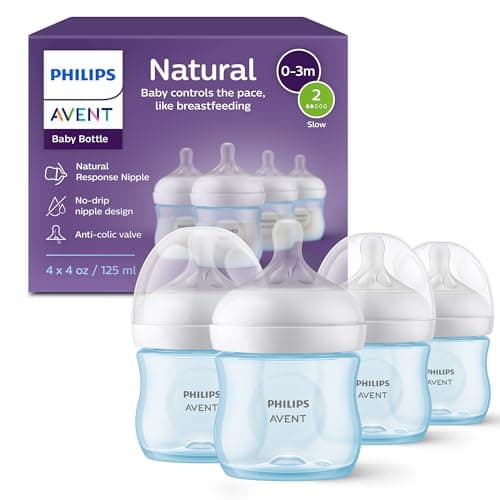
Product photo from the Amazon listing, not a photograph of our own unit.
Philips Avent Natural Bottle with Natural Response Nipple
Philips Avent
The safest default buy: a wide nipple that only releases milk when the baby actively drinks, inside the biggest parts ecosystem on the shelf.
- Latch
- 9
- Colic control
- 8
- Cleaning
- 9
- Durability
- 9
- Value
- 9
- Material:
- Polypropylene, glass and PPSU versions
- Parts to wash:
- Three
- Nipple shape:
- Wide
- Price tier:
- Mid-range
What works
- Flow-on-demand nipple paces the feed more like nursing
- Bottles, nipples, sippy tops and pump parts all interchange
- Available in plastic, glass and PPSU with the same nipples
What to know first
- Venting is milder than Dr. Brown's for a severely windy baby
- Nipple flow numbering confuses first-time buyers
- Wide base does not fit narrow warmer wells
#ad Affiliate link · Price as of October 17, 2026
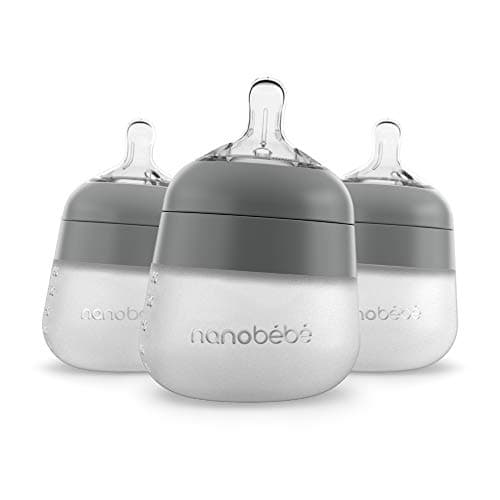
Product photo from the Amazon listing, not a photograph of our own unit.
Nanobebe Flexy Silicone Bottle
Nanobebe
A soft silicone bottle shaped to sit against the body, and one of the easier first bottles for a newborn to accept.
- Latch
- 9
- Colic control
- 7
- Cleaning
- 9
- Durability
- 7
- Value
- 7
- Material:
- Silicone
- Parts to wash:
- Three
- Nipple shape:
- Wide, breast-like
- Price tier:
- Mid-range
What works
- Frequently named a best newborn bottle by review outlets
- Soft body squeezes, which some newborns prefer
- Wide neck is simple to clean
What to know first
- Unusual shape does not fit all sterilizer racks
- No internal vent
- Pricier per bottle than plastic
#ad Affiliate link · Price as of October 17, 2026
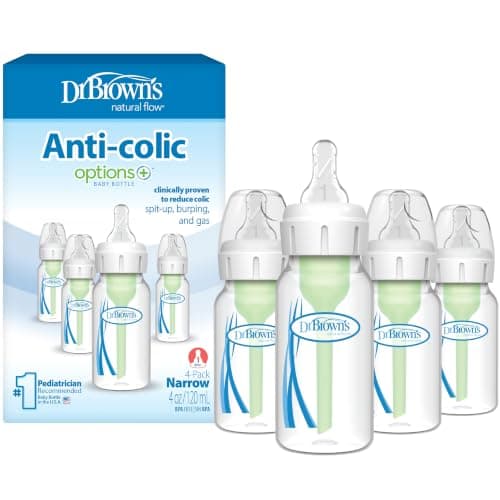
Product photo from the Amazon listing, not a photograph of our own unit.
Dr. Brown's Anti-Colic Options+ Narrow
Dr. Brown's
The anti-colic bottle with the deepest clinical backing. The internal vent genuinely reduces wind, and genuinely adds parts to wash.
- Latch
- 8
- Colic control
- 10
- Cleaning
- 5
- Durability
- 9
- Value
- 8
- Material:
- Polypropylene, glass version available
- Parts to wash:
- Five with the vent, three without
- Nipple shape:
- Narrow
- Price tier:
- Mid-range
What works
- The vent system has the strongest evidence base for reducing gas
- Vent is removable once colic settles, cutting cleaning to three parts
- Nipple flow levels run from preemie upward
What to know first
- Most parts to wash of any bottle here
- The vent can leak if the bottle is over-tightened or over-filled
- Narrow neck makes hand-washing fiddlier
#ad Affiliate link · Price as of October 17, 2026
Common questions
What size bottle should a newborn use?
A 4oz (120ml) bottle. Newborns take a few millilitres at first, rising to around 2 to 3 ounces per feed by the end of the first month, so a small bottle is easier to read accurately and wastes less expressed milk than a large one filled a quarter full.
When should I switch to 8oz bottles?
Around three to four months, when feeds routinely pass about four ounces and you find yourself topping up a 4oz bottle mid-feed. Add 8oz bottles rather than replacing the small ones — the 4oz bottles stay useful for water, medicine and smaller daycare feeds.
How many ounces should a baby drink per feed?
Roughly 2 to 3 ounces in the first month, 3 to 4 at one to three months, and 4 to 6 from three to six months, with most babies settling at a total of around 24 to 32 ounces a day from about one month. Ranges are wide; a content, growing baby is the real measure.
Does a bigger bottle mean a faster nipple?
It should not, but it often happens by accident because large bottles are usually sold with a faster nipple in the box. Move your existing nipple onto the bigger bottle if your baby is feeding well on it. Bottle capacity and flow rate are separate decisions.
What is 4oz in ml for a baby bottle?
About 120ml, since one US fluid ounce is roughly 30ml. An 8oz bottle is about 240ml. Check which scale your bottle is printed in if you are following a plan written in millilitres, and treat moulded graduations as approximate.
Do I need 9oz or 11oz bottles?
Almost certainly not. Breastfed babies' daily intake stays fairly flat after the first month, so individual feeds rarely outgrow an 8oz bottle. A child drinking enough to need an 11oz bottle is usually old enough to be on a cup instead.