Warmers & sterilizers
The best bottle drying racks in 2026
A drying rack is the cheapest thing in this category and the one you use most. The only questions that matter are how much it holds, where the water goes, and how much counter it steals.
How this page is funded: if you buy through a link here we may earn an Amazon commission, at no extra cost to you. It never changes which product we put first, and we recommend the cheaper option whenever it is the better one. Full disclosure.
Buy the Munchkin High Capacity Baby Bottle Drying Rack. It states capacity for up to 16 bottles on adjustable multi-level pegs that fold down flat when you are done, which is the combination nothing else here manages — a full pumping day's worth of parts when you need it, and a rack you can push aside when you do not. It is also the cheapest rack we rank, so it is the budget pick as well as the winner. If your counter is the constraint rather than the capacity, buy the Ubbi Vertical, which stacks 13 pegs upward instead of spreading them out and puts a removable drain tray underneath.

Our pick
Munchkin High Capacity Baby Bottle Drying Rack
Holds up to 16 bottles on pegs that fold down when you do not need them, which is the combination nothing else here manages: a full pumping day's worth of parts, then a flat rack you can push aside.
One honest caveat before you buy it: the Munchkin has no sealed tray of its own, so you are deciding where the drips land. On a draining board that is fine. On a wooden counter it is not, and you want the Ubbi or the Dr. Brown's tower instead.
#ad Affiliate link · Price as of November 28, 2026
Who should buy something else
- Your bottles are glass. Buy the OXO Tot. Silicone-tipped tines rather than bare plastic pegs.
- You have almost no counter at all. Buy the Dr. Brown's Drying Tower, the smallest footprint here.
- You are drying odd shapes — silicone bottles, sippy cups, teethers. Buy the Boon Lawn. Blades, not pegs, so shape stops mattering.
- The real problem is that drying takes hours. A rack will not fix that. A sterilizer-dryer removes the step.
Quick picks
Our ranking, with the reasoning underneath. Tap any row to jump to the full write-up.
| # | Product | Best for | Score | Price |
|---|---|---|---|---|
| 1 | Munchkin High Capacity Baby Bottle Drying Rack Holds up to 16 bottles on pegs that fold down when you do not need them, which is the combination nothing else here manages: a full pumping day's worth of parts, then a flat rack you can push aside. | Drying racks, overall | 8.5 | $11.72$13.79(15% off)View on Amazon #ad Affiliate link · Price as of November 28, 2026 |
| 2 | 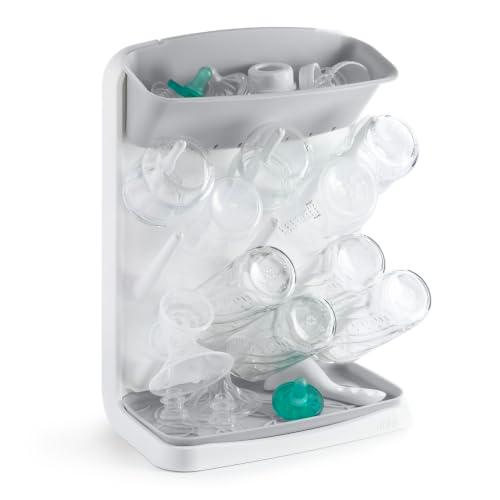 Ubbi Vertical Baby Bottle Drying Rack Thirteen pegs stacked vertically rather than spread flat, with a removable drain tray underneath and a top pocket for the small parts that otherwise disappear. | A small counter | 8.4 | $19.46View on Amazon #ad Affiliate link · Price as of November 28, 2026 |
| 3 | 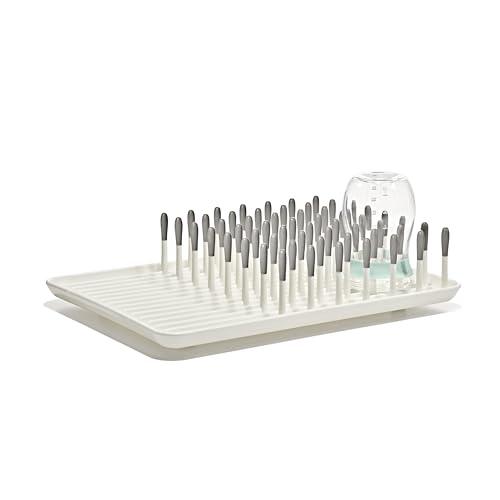 OXO Tot Baby Bottle Drying Rack with Drain Board Silicone-tipped tines instead of bare plastic pegs, which is the detail that matters if the bottles going on it are glass, plus a drain board built into the base. | Glass bottles | 8.0 | $22.98$25.99(12% off)View on Amazon #ad Affiliate link · Price as of November 28, 2026 |
| 4 | 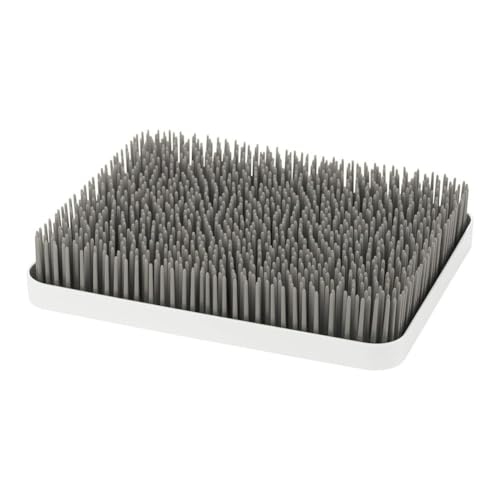 Boon Lawn Countertop Drying Rack The grass-blade mat everybody recognizes: no fixed pegs at all, so it takes any shape you push into it, over an antimicrobial tray that catches the water. | Odd shapes and small parts | 7.9 | $21.99View on Amazon #ad Affiliate link · Price as of November 28, 2026 |
| 5 | 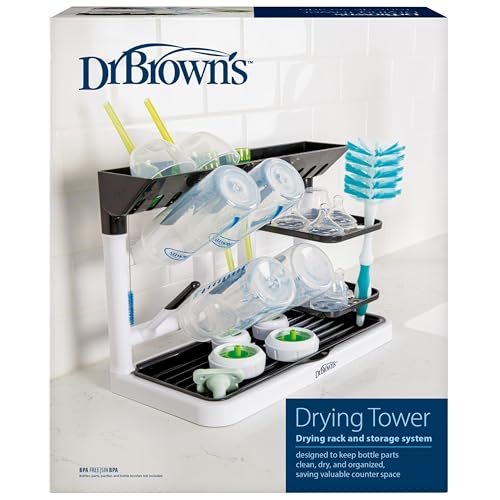 Dr. Brown's Drying Tower A stand-up tower with six pegs and three trays, which is the least counter space any rack here asks for and the cheapest way to stop drying bottles on a tea towel. | The cheapest vertical rack | 7.7 | $15.29$19.99(24% off)View on Amazon #ad Affiliate link · Price as of November 28, 2026 |
Scores are our own research scores on the rubric published at how we choose. They are not star ratings from customers, and we do not show a price we cannot verify live.
Every pick, in detail
Product photo from the Amazon listing, not a photograph of our own unit.
Munchkin High Capacity Baby Bottle Drying Rack
Munchkin
Holds up to 16 bottles on pegs that fold down when you do not need them, which is the combination nothing else here manages: a full pumping day's worth of parts, then a flat rack you can push aside.
- Capacity
- 10
- Drainage
- 6
- Footprint
- 8
- Cleaning
- 7
- Value
- 10
- Stated capacity:
- Up to 16 bottles
- Layout:
- Adjustable multi-level, vertical
- Pegs:
- Fold up and down for setup and storage
- Also holds:
- Valves, straws, nipples, pump accessories, pacifiers
- Price tier:
- Budget
What works
- The largest stated capacity here, which is what an exclusive pumper actually needs
- Pegs fold flat, so the rack stores instead of permanently owning a patch of counter
- Adjustable heights mean tall bottles and short pump parts both sit properly
What to know first
- No sealed drip tray of its own, so where the water goes depends on your counter
- The multi-level design is fiddlier to wipe out than a one-piece mat
- Plastic pegs feel less solid than the pricier racks
#ad Affiliate link · Price as of November 28, 2026
Product photo from the Amazon listing, not a photograph of our own unit.
Ubbi Vertical Baby Bottle Drying Rack
Ubbi
Thirteen pegs stacked vertically rather than spread flat, with a removable drain tray underneath and a top pocket for the small parts that otherwise disappear.
- Capacity
- 8
- Drainage
- 9
- Footprint
- 10
- Cleaning
- 9
- Value
- 8
- Stated capacity:
- 13 pegs
- Layout:
- Vertical, slim standing
- Drainage:
- Removable bottom drain tray
- Small parts:
- Removable top compartment with draining holes
- Dishwasher:
- Rack and removable pieces stated dishwasher safe
What works
- A vertical footprint, so it takes a fraction of the counter a flat mat does
- The top pocket is the answer to losing valves and membranes down the back
- Stated dishwasher safe, which matters because a rack gets slimy and needs real cleaning
What to know first
- Fewer pegs than the Munchkin, so a heavy pumping day needs two rounds
- A tall standing rack is easier to knock than something flat
- Costs more than the budget racks for less raw capacity
#ad Affiliate link · Price as of November 28, 2026
Product photo from the Amazon listing, not a photograph of our own unit.
OXO Tot Baby Bottle Drying Rack with Drain Board
OXO Tot
Silicone-tipped tines instead of bare plastic pegs, which is the detail that matters if the bottles going on it are glass, plus a drain board built into the base.
- Capacity
- 7
- Drainage
- 9
- Footprint
- 6
- Cleaning
- 8
- Value
- 7
- Stated capacity:
- Up to eight bottles
- Tines:
- Flexible, silicone-tipped
- Drainage:
- Built-in drain board with channels
- Also holds:
- Pacifiers and pump parts
- Price tier:
- Mid-range
What works
- Silicone tips are the only thing here designed not to chip or scratch a glass bottle
- Flexible tines take odd bottle shapes that rigid pegs fight with
- The drain board is part of the rack rather than a separate tray to misplace
What to know first
- Eight bottles is modest next to the high-capacity racks
- A flat layout uses real counter space
- Dearer than the budget racks for less capacity
#ad Affiliate link · Price as of November 28, 2026
Product photo from the Amazon listing, not a photograph of our own unit.
Boon Lawn Countertop Drying Rack
Boon
The grass-blade mat everybody recognizes: no fixed pegs at all, so it takes any shape you push into it, over an antimicrobial tray that catches the water.
- Capacity
- 8
- Drainage
- 8
- Footprint
- 5
- Cleaning
- 8
- Value
- 8
- Stated size:
- 13.5 x 11 x 2.5 inches
- Layout:
- Flexible blades, no fixed pegs
- Drainage:
- Antimicrobial bottom tray, stated to resist mold and mildew
- Cleaning:
- Splits into two pieces for washing
- Material:
- Made without BPA or PVC
What works
- Blades rather than pegs, so there is no bottle shape it cannot take
- The antimicrobial tray addresses the one real hygiene worry with a wet rack
- Splits in two, so you can genuinely wash it rather than wiping around it
What to know first
- A big flat footprint — it owns a corner of the counter permanently
- Small parts sink into the blades and are awkward to fish back out
- Water sits in the tray unless you tip it out, which is a daily job
#ad Affiliate link · Price as of November 28, 2026
Product photo from the Amazon listing, not a photograph of our own unit.
Dr. Brown's Drying Tower
Dr. Brown's
A stand-up tower with six pegs and three trays, which is the least counter space any rack here asks for and the cheapest way to stop drying bottles on a tea towel.
- Capacity
- 6
- Drainage
- 8
- Footprint
- 10
- Cleaning
- 7
- Value
- 9
- Stated capacity:
- Six pegs and three trays
- Layout:
- Vertical drying tower
- Drainage:
- Removable bottom drip tray
- Small parts:
- Top compartment for collars, lids and nipples
- Price tier:
- Budget
What works
- The smallest counter footprint of anything here
- Doubles as storage, so dried parts stay in one place instead of a drawer
- Cheap enough to buy alongside a sterilizer rather than instead of one
What to know first
- Six pegs is genuinely few — this is not the rack for exclusive pumping
- Stacked trays mean more pieces to take apart and wash
- Tall and narrow, so it tips more easily than a flat rack
#ad Affiliate link · Price as of November 28, 2026
Do you actually need a drying rack?
Mostly yes, and for a reason that is not obvious. The CDC's guidance on cleaning feeding items is specific about the drying step: after washing, place feeding items on a clean, unused dish towel or paper towel in an area protected from dirt and dust, and do not use a dish towel to rub or pat items dry, because that can transfer germs. A rack exists to satisfy that instruction without covering your counter in paper towels three times a day.
It also solves a problem the dishwasher does not. A dishwasher washes beautifully and then leaves narrow bottles, valves and membranes holding water in exactly the places you cannot see. Anything with a closed end — a bottle, a flange, a pump cup — needs to be inverted over something to drain, and a dish rack designed for plates does that badly.
You can skip a rack entirely in two situations. If you already own a sterilizer-dryer, the drying step is handled inside the machine and a rack is just extra clutter. And if you are feeding two or three bottles a day rather than eight, a clean towel genuinely is enough, which is the honest version of the answer in how to dry baby bottles.
What we ranked these on
A drying rack is a passive object. It has no settings, no cycle and nothing to go wrong, which means the spec sheet is short and every item on it matters. We weighted five things, in this order.
1. Stated capacity, measured against a pumping day rather than a feed. This is the criterion most buyers get wrong, because they count bottles. The load that actually breaks a rack is not six bottles, it is six bottles plus twelve pump parts: flanges, valves, membranes, backflow protectors, connectors and lids, washed at the same time. If you are pumping several times a day you need a rack that states a big number, which is why the Munchkin wins and the Dr. Brown's tower does not.
2. Where the water goes. Every rack drains; they differ in whether they take responsibility for it. A rack with a removable tray contains the water and lets you tip it out. A rack without one hands the problem to your counter. Neither is wrong, but a tray you have to remember to empty is a daily job, and a rack with no tray on an absorbent surface is a slow-motion mistake.
3. Footprint, in the shape your kitchen has. Counter space is the real currency here. A flat mat like the Boon Lawn claims roughly 13.5 by 11 inches and keeps it, permanently. A vertical rack claims a fraction of that and goes upward instead, which is free space in most kitchens and a problem only if you have low wall cabinets. If your kitchen is already tight, this criterion outranks capacity — the same logic that drives our small-space picks in a different category.
4. Whether the rack itself can be cleaned. A drying rack is permanently wet, and permanently wet plastic in a warm kitchen grows things. The racks worth owning either come apart (the Boon Lawn splits in two) or state that they are dishwasher safe (the Ubbi). A rack you can only wipe around is a rack that eventually gets slimy in the joints where you cannot reach.
5. What it does with the small parts. Valves, membranes and nipples are the pieces that get lost, and they are also the pieces that most need airflow. A rack with a dedicated top compartment — the Ubbi and the Dr. Brown's both have one — solves a real daily annoyance. A blade mat does the opposite: small parts sink in and have to be fished back out.
What we did not rank on: looks, colorway, or anything a maker describes as antimicrobial without saying what that means in practice. We have not tested any of these racks and we do not claim to — every figure on this page is the maker's own stated capacity or dimension, taken from the live listing.
| Rack | Stated capacity | Shape | Where the water goes | Small-parts solution |
|---|---|---|---|---|
| Munchkin High Capacity | Up to 16 bottles | Vertical, adjustable multi-level, pegs fold flat | Drains down the rack, onto whatever is under it | Pegs sized for valves, straws, nipples and pump parts |
| Ubbi Vertical | 13 pegs | Slim vertical standing | Removable bottom drain tray | Removable top compartment with draining holes |
| OXO Tot with Drain Board | Up to eight bottles | Flat, flexible silicone-tipped tines | Drain board built into the base | Room on the board for pacifiers and pump parts |
| Boon Lawn | 13.5 x 11 x 2.5 inches of blades | Flat mat, no fixed pegs at all | Antimicrobial bottom tray | None — small parts sink into the blades |
| Dr. Brown's Drying Tower | Six pegs and three trays | Tall vertical tower | Removable bottom drip tray | Top compartment for collars, lids and nipples |
Munchkin High Capacity — the one to buy
Munchkin states capacity for up to 16 bottles, with an adjustable multi-level design and pegs that fold up and down for setup and storage. That is two advantages in one object. The capacity means a rack that still works on the worst day — the day you wash every bottle in the house and a full set of pump parts at once — rather than the average day. The folding pegs mean it does not punish you for that capacity when you are not using it.
The adjustable heights matter more than they sound. A rack with one peg height makes you choose between a tall bottle standing properly and a short pump connector sitting on a peg that goes most of the way through it. Being able to move them means the awkward middle sizes — 4oz bottles, flange bodies, sippy cup lids — get somewhere sensible.
The honest cons. There is no sealed drip tray, so the water goes wherever the rack is standing: fine on a draining board beside the sink, bad on wood or on a counter you want dry. The multi-level construction is fiddlier to wipe out than a one-piece mat, and the plastic feels less substantial than the pricier racks here. For the lowest price on this page, those are reasonable trades — but if any of them is a dealbreaker, buy the Ubbi.
Ubbi Vertical — the small-counter answer
Thirteen pegs arranged upward in a slim standing frame, a removable bottom drain tray, and a removable top compartment with draining holes for the small parts. Ubbi also states that the rack and its removable pieces are dishwasher safe, which is the single most useful claim any maker makes in this category: it means the rack can be properly cleaned rather than endlessly wiped.
This is the rack to buy if your kitchen is the constraint. It gives up raw capacity to the Munchkin and gets back a footprint a fraction of the size, a tray that contains the water, and a dedicated home for the valves and membranes that otherwise end up behind the kettle. If you are already fighting for counter space with a warmer and a sterilizer, that trade is usually the right one.
The honest cons. Thirteen pegs is fewer than sixteen, and on a heavy pumping day you will be doing two rounds. A tall standing rack is also easier to knock over than something flat, which matters if it lives next to a toddler's reach. And it costs more than the budget racks while holding less, which only makes sense if you are buying the footprint.
OXO Tot with Drain Board — the one for glass
OXO states up to eight bottles on flexible, silicone-tipped tines, over a drain board built into the base. The silicone tips are the reason this rack is on the page: OXO's own listing says they are there to prevent chipping or scratching, and a glass bottle dropped onto a bare plastic peg is exactly how a glass bottle gets a chip you then have to throw it out for.
If you are feeding from glass bottles, that detail is worth more than two extra pegs. The flexible tines also handle odd shapes that rigid pegs fight with — squat silicone bottles, wide-neck bodies — and the drain board being part of the rack rather than a separate tray means there is one less piece to misplace.
The honest cons. Eight bottles is modest next to the high-capacity racks, and it is a flat design, so it uses real counter space to deliver that smaller number. It also costs more than the budget racks. This is a rack you buy for one specific reason, and if your bottles are plastic that reason does not apply to you.
Boon Lawn — the one with no pegs at all
The grass-blade mat everyone recognizes, stated at 13.5 by 11 by 2.5 inches, over an antimicrobial tray that Boon says resists mold and mildew growth. It splits into two pieces for washing and is made without BPA or PVC.
Its real advantage is that it has no fixed geometry. Pegs assume a bottle shape; blades do not. Push a Comotomo, a sippy cup, a teether, a breast pump flange and a bottle brush into the same patch of lawn and it accommodates all of them, which is why this design has survived a decade of competitors. The antimicrobial tray also addresses the one genuine hygiene worry with any rack, which is that the water underneath it sits there.
The honest cons. It is the biggest permanent footprint here — a flat mat owns its corner of the counter whether or not anything is drying on it. Small parts sink between the blades and are awkward to retrieve, which is the exact opposite of what the Ubbi and the Dr. Brown's do with their top compartments. And the tray only works if you tip it out, which becomes another daily job on a list that is already long.
Dr. Brown's Drying Tower — the cheapest vertical
Six pegs and three trays in a stand-up tower, with a removable bottom drip tray and a top compartment for collars, lids and nipples. Dr. Brown's positions it as drying and storage, which is a fair description: dried parts can stay in the tower rather than migrating to a drawer.
It asks for the least counter space of anything on this page, and it is cheap. If you are a once-or-twice-a-day bottle household who wants to stop draping things on a tea towel, this is the smallest, cheapest way to do it properly.
The honest cons. Six pegs is genuinely few. This is not the rack for exclusive pumping, and we would rather say that than let you find out on a Tuesday night. The stacked trays mean more pieces to take apart and wash than a simple rack, and a tall narrow tower tips more easily than something flat.
A rack or a sterilizer-dryer?
Worth settling before you spend anything, because these solve overlapping problems at very different prices.
A rack costs very little, needs no power, holds a lot, and dries things at the speed air dries things — which, for a narrow bottle, is hours. A sterilizer-dryer costs substantially more, lives permanently on the counter, needs descaling, and hands you dry, sterile parts in one cycle. The honest framing is that the machine is buying you time, not cleanliness: both routes get items clean, but only one of them has your bottles ready in forty minutes.
Most households end up with both, and that is not waste. The machine takes the daily bottles; the rack takes the overflow, the pump parts washed between cycles, and the things the machine's basket does not fit. If you are deciding which to buy first, our view is in do I need a bottle sterilizer, and the machines themselves are ranked in the best sterilizers for breast pump parts. Worth knowing before you spend on either: most families can stop sterilizing earlier than they expect — when to stop sterilizing baby bottles.
Stopping the rack from becoming the problem
This is the part no listing mentions. A drying rack is a wet plastic object that lives on a warm counter and is never itself washed, which is a description of somewhere mold likes to grow. Four habits keep it honest.
- Empty the tray every single day. Standing water is the whole problem. Racks with no tray avoid this failure mode and create a different one, which is why we weighted drainage so heavily above.
- Wash the rack itself weekly. Hot soapy water, into the joints, or the dishwasher where the maker says that is allowed. Put it on the same schedule as your other feeding kit — how to wash baby bottles.
- Do not let items sit on it for days. Once dry, parts should be put away. A rack is a drying station, not a cupboard — the Dr. Brown's tower is the one exception here, because it is explicitly designed to store as well.
- Keep it away from the sink splash zone. Clean items catching dirty water from washing up defeats the point of washing them, and the CDC is explicit that the drying area should be protected from dirt and dust.
The same logic applies to the parts themselves. Pump valves and membranes wear out on a schedule whether or not they look fine, and a rack full of tired membranes dries them just as well as new ones — see how often to replace breast pump parts.
Worth saying plainly
Air-dry feeding items on a clean rack or an unused dish towel in a spot protected from dirt and dust, and do not rub or pat them dry with a towel — the CDC warns that this can transfer germs. Make sure items are fully dry before you put them away; residual moisture inside a sealed bottle is the thing you are trying to avoid. Wash the rack itself regularly, and replace any rack with cracks, discoloration or a smell you cannot wash out. None of these racks sterilize anything — drying is not sterilizing, and a rack is no substitute for cleaning items properly first. Check any product against CPSC recalls. We are not clinicians and nothing here is medical advice.
A rack handles the step after washing. The step before it has its own shortlist: the best bottle brushes, including why the CDC asks for a brush kept only for feeding items.
How we chose
Researched, not hands-on, and labeled that way on every card. Every capacity, dimension and material claim on this page is the maker's own, taken from the live Amazon listing for each rack on 12 November 2026, and every one of the five returned an in-stock offer with a price on that date — which is how we check a product is genuinely purchasable before featuring it. Where a maker states a number we quote it as their number; where they do not, we say nothing rather than estimating.
Drying and hygiene guidance comes from the CDC's page on cleaning feeding items and its pump hygiene guidance; material guidance from the FDA; independent hands-on testing of the adjacent sterilizer category from Babylist and Consumer Reports. Capacity and drainage carry the most weight here; appearance carries none. Rubric: how we choose.
One listing note worth recording, because it is the kind of thing that quietly rots a roundup: the OXO Tot “Space Saving Drying Rack” that most older lists recommend now shows as currently unavailable on Amazon. The OXO rack featured above is the Drying Rack with Drain Board, which is the one you can actually buy today.
Common questions
What is the best bottle drying rack?
The Munchkin High Capacity, which states room for up to 16 bottles on adjustable pegs that fold flat when you are not using them — and it is also the cheapest rack we rank. Buy the Ubbi Vertical instead if counter space, not capacity, is your constraint.
Do I need a bottle drying rack if I have a dishwasher?
Usually yes. A dishwasher washes well but leaves narrow bottles, valves and membranes holding water where you cannot see it, and the CDC says to air-dry feeding items rather than towel them dry. A rack is how you do that without covering the counter in paper towels.
Which drying rack is best for glass bottles?
The OXO Tot with Drain Board. Its tines are silicone-tipped specifically to avoid chipping and scratching, which is the failure mode that ends a glass bottle's life. Our glass bottle picks are on the best glass baby bottles.
Is a drying rack better than a sterilizer-dryer?
It is far cheaper and holds more; a sterilizer-dryer is far faster and hands you dry parts in one cycle. The machine buys time, not cleanliness. Many households own both and use the rack for overflow and pump parts.
How do you clean a bottle drying rack?
Empty the tray daily and wash the rack itself in hot soapy water weekly, or in the dishwasher where the maker says that is allowed — the Ubbi states its rack and removable pieces are dishwasher safe, and the Boon Lawn splits in two for washing.
How long do bottles take to air-dry on a rack?
Several hours for a narrow bottle, less for wide-neck ones, and it depends entirely on airflow and how well the item drains. If that is too slow for your routine, the fix is a sterilizer-dryer, not a different rack.
Does a drying rack sterilize bottles?
No. Drying is not sterilizing and no rack claims otherwise. Wash items properly first, then dry them — and see when to stop sterilizing baby bottles for whether you still need the sterilizing step at all.