Baby bottles
MAM vs Dr. Brown's: which anti-colic bottle should you buy?
Both put the air somewhere other than your baby's stomach. One does it with a vented base and sterilizes itself; the other does it with a tube you wash and can throw away later.
How this page is funded: if you buy through a link here we may earn an Amazon commission, at no extra cost to you. It never changes which product we put first, and we recommend the cheaper option whenever it is the better one. Full disclosure.
The short answer
Buy MAM Easy Start if washing is your limiting factor, or if you will be making bottles away from your own kitchen. Four parts, nothing to thread, and the bottle sterilizes itself in a microwave in three minutes — which is genuinely useful in a hotel room or an office kitchen. Buy Dr. Brown's Anti-Colic Options+ if gas, spit-up or reflux is already the problem you are solving, if your baby was premature or is very small, or if you want the option of dropping to a three-part bottle in a few months. Dr. Brown's has the slower flow levels, a glass version and a vent that lifts out; MAM has the easier daily routine.
Quick picks
Our ranking, with the reasoning underneath. Tap any row to jump to the full write-up.
| # | Product | Best for | Score | Price |
|---|---|---|---|---|
| 1 | 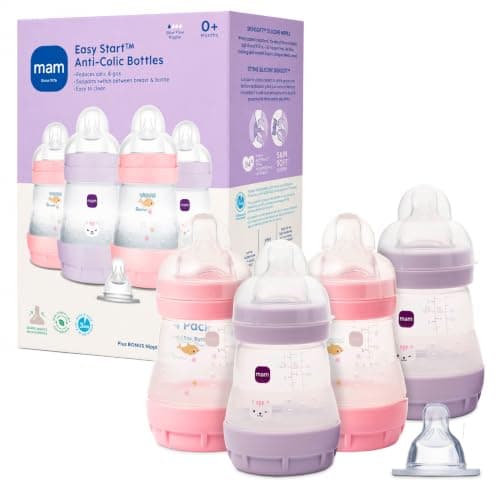 MAM Easy Start Anti-Colic Its base unscrews so the bottle sterilizes itself in a microwave, which is genuinely useful in a hotel room or an office kitchen. | Self-sterilizing | 8.2 | $29.99View on Amazon #ad Affiliate link · Price as of November 6, 2026 |
| 2 | 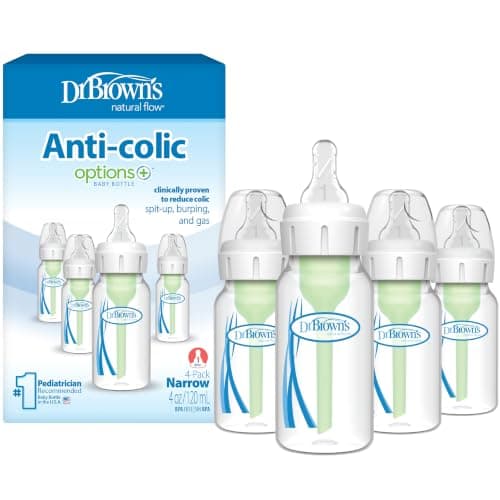 Dr. Brown's Anti-Colic Options+ Narrow The anti-colic bottle with the deepest clinical backing. The internal vent genuinely reduces wind, and genuinely adds parts to wash. | Gas and colic | 8.6 | $23.99View on Amazon #ad Affiliate link · Price as of November 6, 2026 |
| 3 | 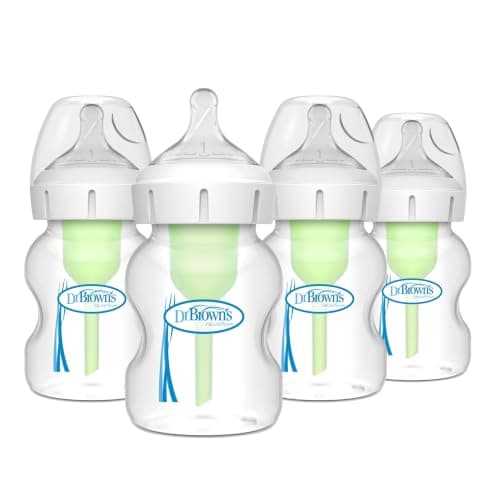 Dr. Brown's Anti-Colic Options+ Wide-Neck Dr. Brown's venting behind a wide, breast-shaped nipple. The compromise pick when your baby is gassy and nursing. | A gassy breastfed baby | 8.7 | $24.99View on Amazon #ad Affiliate link · Price as of November 6, 2026 |
Scores are our own research scores on the rubric published at how we choose. They are not star ratings from customers, and we do not show a price we cannot verify live.
Side by side
| What matters | MAM Easy Start Anti-Colic | Dr. Brown's Anti-Colic Options+ |
|---|---|---|
| Where the air goes | A vented base in the bottom of the bottle, with nothing inside the milk | An internal vent tube that carries air past the milk to the back of the bottle |
| Parts to wash per bottle | Four, including the vented base | Five with the vent in, three with it out |
| Can you simplify it later? | No. The base is the bottle; there is nothing to remove | Yes — the maker says the vent can come out as feeding develops, with no change of bottle |
| Self-sterilizing | Yes. MAM says it sterilizes itself in a microwave in three minutes with a splash of water, and stays clean up to 48 hours left untouched in that position | No. It is dishwasher safe (top rack), and takes electric or microwave sterilizers and boiling water |
| Nipple shape | Wide, flat, pre-compressed SkinSoft silicone | Breast-shaped. Narrow and wide-neck ranges, so you pick the shape |
| Slowest flow available | Slow flow from newborn; no published step below it | Preemie and Ultra-Preemie flows below the newborn level |
| Glass version | No | Yes, in both neck widths |
| Fits a narrow warmer well | Not always — the base makes it wider at the bottom | Yes, the narrow version does |
| The maker's colic claim | "Reduces colic symptoms in 80% of babies" — MAM's own figure | "Clinically proven to reduce colic" — Dr. Brown's own phrasing |
| Price tier | Mid-range | Mid-range |
Three rows carry this page. Where the air goes, because that is the design difference everything else follows from. Parts to wash, because that is the number you live with six times a day. And the slowest flow available, which is the row that decides it outright for a small or premature baby.
The venting: a base against a tube
Both bottles exist to stop your baby drinking against a vacuum. Venting is the general name for letting air into the bottle to replace the milk coming out, so the nipple does not collapse and the baby does not have to break their seal to breathe and swallow air doing it.
MAM puts the vent in the base. The bottom of the bottle unscrews and carries the vent, so air enters underneath the milk and nothing sits inside the bottle at all. MAM states the vented base is clinically proven to reduce colic symptoms in 80% of babies, and that the base works with the SkinSoft nipple to reduce the bubbles a baby swallows.
Dr. Brown's puts the vent inside. A tube runs down the middle of the bottle and carries incoming air to the back, past the milk, so the milk itself stays still and the flow stays even. Dr. Brown's states the system is clinically proven to reduce colic and decreases spit-up, burping and gas, and that it delivers vacuum-free feeding at a consistent flow rate.
How to read both of those claims. They are manufacturer claims, and we are not going to pretend otherwise. MAM's 80% figure is footnoted on its own listings to a small US test of mothers of colicky babies — a few dozen participants, commissioned by the brand. Dr. Brown's "clinically proven" is the maker's phrasing too, although the internal-vent approach is the one with the longest track record in US hospitals and NICUs, and Dr. Brown's states its Options+ is the #1 pediatrician-recommended bottle in the US. We rate Dr. Brown's venting as the better-evidenced of the two and still would not tell you either bottle will cure colic, because most infant spit-up is normal and no bottle fixes a feeding problem that is really about pace or position. Our ranking of the whole category is the best anti-colic bottles.
Parts to wash, and the number that actually matters
Counting what you actually wash after a feed and leaving travel caps out of it: MAM is four — bottle, vented base, nipple, collar. Dr. Brown's is five with the vent in — bottle, nipple, collar, and the vent's two pieces — and three with the vent out.
One part does not sound like much. It is, for two reasons. The first is that the Dr. Brown's vent is the fiddly part: a narrow tube that needs a brush through it every wash, and the thing most likely to get left in the bottom of the sink. The second is volume — at six to eight bottles a day, one extra fiddly part is forty-plus extra small washing jobs a week. Our routine for both, including what the CDC actually requires, is in how to wash baby bottles.
MAM's compensation for the extra join is that the whole bottle comes apart flat. Unscrewing the base means you can get a cloth or a brush at every internal surface without reaching down a neck, which is why it is easier to clean properly than its part count suggests. The cost of that join is the obvious one: another place to leak if you do not seat the base squarely. That is the single most common MAM complaint, and it is a technique problem rather than a defect — the base has to go on straight and firm, not over-tightened.
Dr. Brown's has the better long game here, and this is the row people miss when they buy. The vent comes out. Dr. Brown's says the bottle works best with the vent in place but that it can be removed as feeding develops, with no need to change bottle. So the five-part bottle becomes a three-part bottle at around the point colic typically settles, and you did not buy a second set. MAM has no equivalent move: the base is the bottle.
MAM's one trick nothing else here does
Put 20ml of water in the unscrewed base, stand the parts in the self-sterilizing position, close it, and microwave it for three minutes. MAM says the bottle then stays clean for up to 48 hours if it is left untouched that way.
That is a real feature with a real use case, and it is not about the daily routine at home — a dishwasher does that job better. It is about everywhere else: a hotel room, a relative's house, an office kitchen, a long trip. You need a microwave and water and nothing else, and you are not carrying a sterilizer bag or hunting for a clean pot.
Two honest caveats. Sterilizing is not the same as washing, and it never replaces it: milk residue has to come off first or you are sterilizing a dirty bottle. And for most healthy full-term babies with safe tap water, the CDC treats sanitizing as an extra step that matters most for babies under three months, babies born prematurely and babies with a weakened immune system — daily thorough washing is the requirement. So MAM's trick is a convenience for the first months and for travel, not a reason to think you need to sterilize more often than you do. That argument in full: do I need a bottle sterilizer? and how often to sterilize bottles.
Dr. Brown's is not shut out of this. Its listing confirms the bottles are safe in the dishwasher on the top rack, in electric and microwave sterilizers, and in boiling water — it just needs one of those things to exist wherever you are. The methods are compared in how to sterilize baby bottles.
The nipple: a flat wide shape against a breast shape and a flow ladder
This is where the decision turns for a lot of babies, because a bottle your baby refuses has no other qualities worth discussing.
MAM's SkinSoft nipple is wide, flat and pre-compressed — shaped more like a nipple being fed from than like a breast at rest. MAM says that design gets 94% acceptance, a figure the brand attributes to its own market research. Many babies take it immediately. Babies who want something rounder and more breast-like often do not, and that is not a quality judgment on either party.
Dr. Brown's nipple is breast-shaped, and the range is the real argument: a narrow neck version and a wide-neck version, so you can match the shape to the baby rather than hoping. The wide-neck is usually the easier shape for a baby who is also nursing, which is why it is the one we rank in best bottles for breastfed babies.
And then the row that ends the argument for some families. Dr. Brown's publishes flow levels below newborn: a Preemie flow and an Ultra-Preemie flow. MAM starts at slow flow and publishes nothing beneath it. If your baby was premature, is very small, tires during feeds, or coughs and sputters on a standard slow-flow nipple, that single fact decides this page — buy Dr. Brown's. See best bottles for preemies and bottle nipple flow sizes.
Shape, warmers and the things that annoy you later
Warmer wells. MAM bottles are wider at the bottom because of the base, and the wide-mouth shape does not drop into every narrow warmer well. Dr. Brown's narrow bottles fit essentially every warmer made, and its wide-neck bottles fit most. If you already own a warmer, check it before you commit to a bottle system — our warmer picks and what each one swallows are in the best bottle warmers, and the two warmers people most often choose between go head to head in Baby Brezza vs Dr. Brown's — one of which takes any bottle shape and the other of which does not.
Glass. Dr. Brown's has a glass version of Options+ in both neck widths. MAM does not offer glass in its US Easy Start range. If you want glass for taste neutrality, scratch resistance or because you would rather not heat plastic at all, Dr. Brown's is the only one of the two in that conversation — the field is in the best glass baby bottles and the trade-offs in glass vs plastic baby bottles.
Growing with the baby. Both ranges let you keep the bottle and change the nipple as flow needs increase. MAM states its bottles work with all MAM nipple sizes and flows; Dr. Brown's nipples step up through the same necks. Neither locks you in worse than the other here.
Where they are made and what of. MAM states its bottles are manufactured in Europe and are BPA and BPS free. Dr. Brown's Options+ is BPA free and recyclable. For context on what BPA-free does and does not mean, the FDA's position on BPA in food-contact materials is the thing to read rather than a marketing page.
Buy MAM if…
Washing is the chore that will decide whether you stay sane. Four parts, no tube to brush, and a bottle that comes apart flat so you can actually reach everything. Buy it too if you will be making bottles somewhere that is not your kitchen — the three-minute microwave self-sterilize is the most genuinely useful travel feature in this whole category, and it is why MAM is on our daycare bottle list.
What you give up. The vent is permanent, so your five-part problem never becomes a three-part one — except MAM never had five, which is the point. No flow level below slow, so this is the wrong bottle for a preemie or a very small baby. No glass option. The extra join can leak if the base goes on crooked. And the flat wide nipple is a shape some babies simply refuse.
Buy Dr. Brown's if…
Gas, grunting, spit-up or reflux is already happening, or your baby is premature or small. The internal vent is the better-engineered and better-evidenced of the two systems, the flow ladder goes down to Ultra-Preemie, and it is the bottle US hospitals and NICUs actually hand out. Buy it too if you like the idea of a simpler bottle later: the vent lifts out and you keep the same bottle.
What you give up. The highest parts count in mainstream bottles while the vent is in, including a tube that needs a brush. Over-tightening or over-filling can make the vent leak. The narrow neck is fiddlier to hand-wash. And no self-sterilizing trick, so away from home you need a sterilizer, a microwave bag or a pot. Our wider rankings put it first in best bottles for reflux and near the top of the best baby bottles.
The verdict
If your baby is healthy, full term and feeding fine: MAM. Fewer parts, no tube, sterilizes itself anywhere there is a microwave. It is the easier bottle to live with and that counts for more at week three than any specification.
If gas or reflux is the reason you are reading this, or your baby is small or premature: Dr. Brown's Options+. Narrow if you want the slimmest bottle and the best warmer fit, wide-neck if your baby is also nursing. The slower flows and the removable vent are the reasons, in that order.
Do not buy six of either. Buy one or a small pack, find out what your baby accepts, then buy the rest — how many bottles do I need? has the actual numbers by feeding style. If your baby is refusing whatever you have already, the next thing to change is usually pace rather than brand: paced bottle feeding and baby won't take a bottle.
Worth saying plainly
No bottle treats colic, reflux or a medical feeding problem. Persistent crying, forceful or bloody vomiting, poor weight gain, choking or coughing during feeds, or refusing to feed are reasons to call your pediatrician rather than to buy a different bottle — the AAP's guidance on reflux and GERD in infants sets out the difference between the two. Wash feeding items after every use and follow the CDC's cleaning, sanitizing and storage routine; sanitizing is the extra step, never a substitute for washing. Replace nipples when they look thin, sticky, swollen or cracked, and never prop a bottle or leave a baby feeding unattended. We are not clinicians and nothing here is medical advice.
How we chose
Researched, not hands-on, and every product card says so. Part counts, vent design, nipple shape, self-sterilizing instructions and timings, flow levels, materials and dishwasher and sterilizer compatibility come from each product's own specification page where one was reachable — Dr. Brown's Options+, Dr. Brown's Preemie flow and Ultra-Preemie flow — and otherwise from the live retail listing, which we also used to confirm both bottles are currently purchasable on the day this page was published. MAM's own US product page would not serve at the time of writing, so every MAM figure above is attributed to MAM rather than presented as a tested result, and the 80% colic claim is reported as the manufacturer's with its footnote described rather than quoted as independent evidence. Spit-up and reflux context is from the AAP, cleaning and sanitizing from the CDC, and BPA context from the FDA. Independent hands-on testing of the bottle field comes from Mommyhood101. We do not publish star ratings or review counts. Full rubric: how we choose.
What we would buy
Now that the decision is made, these are the products we would actually put in the basket, and why.
Product photo from the Amazon listing, not a photograph of our own unit.
MAM Easy Start Anti-Colic
MAM
Its base unscrews so the bottle sterilizes itself in a microwave, which is genuinely useful in a hotel room or an office kitchen.
- Latch
- 8
- Colic control
- 8
- Cleaning
- 8
- Durability
- 8
- Value
- 9
- Material:
- Polypropylene
- Parts to wash:
- Four
- Nipple shape:
- Wide, vented base
- Price tier:
- Mid-range
What works
- Self-sterilizes in a microwave with a splash of water
- Vented base reduces gas without a long internal straw
- The unscrewing base makes scrubbing easy
What to know first
- One more join means one more place to leak
- Four parts, not three
- Nipple is flatter than the wide breast-shaped designs
#ad Affiliate link · Price as of November 6, 2026
Product photo from the Amazon listing, not a photograph of our own unit.
Dr. Brown's Anti-Colic Options+ Narrow
Dr. Brown's
The anti-colic bottle with the deepest clinical backing. The internal vent genuinely reduces wind, and genuinely adds parts to wash.
- Latch
- 8
- Colic control
- 10
- Cleaning
- 5
- Durability
- 9
- Value
- 8
- Material:
- Polypropylene, glass version available
- Parts to wash:
- Five with the vent, three without
- Nipple shape:
- Narrow
- Price tier:
- Mid-range
What works
- The vent system has the strongest evidence base for reducing gas
- Vent is removable once colic settles, cutting cleaning to three parts
- Nipple flow levels run from preemie upward
What to know first
- Most parts to wash of any bottle here
- The vent can leak if the bottle is over-tightened or over-filled
- Narrow neck makes hand-washing fiddlier
#ad Affiliate link · Price as of November 6, 2026
Product photo from the Amazon listing, not a photograph of our own unit.
Dr. Brown's Anti-Colic Options+ Wide-Neck
Dr. Brown's
Dr. Brown's venting behind a wide, breast-shaped nipple. The compromise pick when your baby is gassy and nursing.
- Latch
- 9
- Colic control
- 10
- Cleaning
- 6
- Durability
- 9
- Value
- 8
- Material:
- Polypropylene, glass version available
- Parts to wash:
- Five with the vent fitted
- Nipple shape:
- Wide
- Price tier:
- Mid-range
What works
- Wide nipple is easier for a nursing baby to accept than the narrow version
- Same vent system as the narrow Options+
- Easier to hand-wash than the narrow neck
What to know first
- Still five parts with the vent in
- Bulkier in a diaper bag
- Wide bottles fit fewer warmer wells
#ad Affiliate link · Price as of November 6, 2026
Common questions
Are MAM or Dr. Brown's bottles better for colic?
Dr. Brown's, on the evidence available. Both makers claim their venting reduces colic, but the internal vent tube is the longer-established design, it is the bottle most used in US hospitals and NICUs, and Dr. Brown's states it is clinically proven to reduce colic and decrease spit-up, burping and gas. MAM's 80% figure is its own, footnoted to a small brand-commissioned test. Neither bottle cures colic — see best anti-colic bottles.
How many parts does each bottle have?
MAM is four: bottle, vented base, nipple and collar. Dr. Brown's is five with the vent fitted and three with it removed. The part count understates the difference, because the Dr. Brown's vent is a narrow tube that needs a brush put through it every wash, while the MAM base simply unscrews.
Do MAM bottles really sterilize themselves?
In a microwave, yes. You add a small amount of water to the unscrewed base, stand the parts in the self-sterilizing position and microwave for three minutes; MAM says the bottle then stays clean for up to 48 hours left untouched that way. It does not replace washing — milk residue has to be cleaned off first. It is most useful away from home.
Which is better for a breastfed baby?
Dr. Brown's wide-neck Options+ for most, because the breast-shaped nipple on a wide neck is the easier shape to transfer onto. MAM's nipple is flatter and pre-compressed, and babies either take it straight away or refuse it. Either way, pace matters more than brand — best bottles for breastfed babies.
Which one works for a premature or very small baby?
Dr. Brown's, without much argument. It publishes Preemie and Ultra-Preemie flow levels below the standard newborn nipple; MAM starts at slow flow and publishes nothing below it. See best bottles for preemies.
Can you remove the MAM vented base like the Dr. Brown's vent?
No. The base unscrews for cleaning, but it is part of the bottle and the bottle does not work without it. The Dr. Brown's vent is different: the maker says it can be taken out as feeding develops, turning a five-part bottle into a three-part one with no change of bottle.
Do MAM bottles fit in a bottle warmer?
Sometimes not. The vented base makes the bottle wider at the bottom, and wide-mouth bottles are the shape least likely to drop into a narrow warmer well. Dr. Brown's narrow bottles fit almost every warmer made. Check your warmer's well before committing to a bottle system — the best bottle warmers lists what each one takes.
Is there a glass version of either?
Dr. Brown's offers Options+ in glass in both neck widths. MAM does not offer glass in its US Easy Start range. If glass matters to you, start with the best glass baby bottles.
Sources
- Dr. Brown's — Natural Flow Anti-Colic Options+ Narrow bottle specification
- Dr. Brown's — Preemie Flow bottle set
- Dr. Brown's — Narrow bottle nipple, Ultra-Preemie flow
- CDC — How to Clean, Sanitize, and Store Infant Feeding Items
- American Academy of Pediatrics (HealthyChildren.org) — Why Babies Spit Up
- American Academy of Pediatrics (HealthyChildren.org) — Gastroesophageal Reflux (GER) and GERD
- FDA — Bisphenol A (BPA): Use in Food Contact Application
- Mommyhood101 — Best Baby Bottles, tested and reviewed